|
Home
|
PETA Undercover At Kosher Butchery In Iowa
Videotapes Show Grisly Scenes at Kosher Slaughterhouse:
The plant, run by Agriprocessors Inc. in Postville, Iowa, is being denounced as inhumane by the group, People for the Ethical Treatment of Animals, and by several experts on animal science and kosher practice.
PETA Undercover: Terrified cows stagger to their feet after workers rip out their throats.
Luke says: I'm a vegetarian. Never eaten meat in my life thanks to my Seventh Day Adventist upbringing. I think it is what God wants (see Garden of Eden, prophetic prophecy in Isaiah).
From The Stern College Dorm (Orthodox School For Girls In NY)
i have a big paper to write and no motivation. my body is tired.
Luzdedos1: XOXO
you're really helpful.
its funny because if i were telling this to my boyfriend, and he gave me practical ideas, id be like "i dont need a solution! just listen to me!"
Luzdedos1: bask in god's love
i had an hour long conversation with a girl today over dinner about getting married with no money and having emunah
im exhausted and cant even go to sleep because there are no sheets on my bed and im too tired to put some on
is this sleepaway camp, why are people singing in the halls
Luzdedos1: sounds snuggly
it angers me.
i want quiet where i live.
Luzdedos1: cherish what you have, you will look back on it fondly
no i will not
i will look back on living with my roommate
i will not look back on anything else about it
other than being in the city
not only are they singing, but its someone who thinks she has a good voice
shes gettinig all trill-ish
do you read chez miscarriage?!
her surrogate is pregnant!
God Loves Jews
Can we as Jews do more of that God love you stuff that Christians pull off so well? Should we try to guide people into having a personal relationship with God and to feeling that the Almighty cares deeply about their life?
I think some rabbis can pull this off (Avraham Twersky, Mordecai Finley, Mordecai Gafni, Hershy Worch) but most can't and it is important for Jews to construct good solid communities where people know who they are and what is expected and they can socialize with fellow Jews who observe similarly and can make deep bonds with their fellow Jews.
Our Moral Leader comes down from his high horse
High Praise From Cathy's Father Harvey
Harvey Seipp loved my book Yesterday's News Tomorrow: Inside American Jewish Journalism and he asked me to get him four copies.
So I ordered 30 copies of my book and sent out a handful as gifts and review copies. The rest I will sell.
I told Cathy I have her dad's books. She tells me to call him. "He'd be delighted to hear from you and says your memoir, which he was reading, is almost as good as Thomas Hardy."
Harvey calls me back Monday morning. "I'm impressed by the intellectual depth of your books," he says. "You're so monosyllabic when you're around the house. I just read XXX-Communicated. I was almost in tears at the end. You delineated so honestly the conflict between flesh and spirit. Hemingway would've been impressed by the honesty of your style.
"I just got finished with two of Thomas Hardy's books, Jude the Obscure and The Return of the Native. What a great talent but hard to read. Then I read yours, and I told Cathy, gee, I really enjoy this. He's so clear and strong and honest.
"Then I read Yesterday's News Tomorrow. That's a scholarly piece of work. I was never religious. I could never relate to religion. I learned more about my Jewish background from reading you than I had ever read before."
Luke, I am your....Brother
The NAMBLA Rabbi
Rabbi/Child Psychiatrist (Alan J.) Shneur Horowitz (Hagerstown, MD; Israel; Schenectady, NY; California; Woodward, IA)
On July 27, 1992, Alan J. Horowitz of Schenectady, New York was sentenced to ten to twenty years in prison for sodomizing a nine-year-old psychiatric patient the previous year. Allegedly, he has assaulted a string of children from California to Israel to New York in the past twenty years. Alan J. Horowitz is an Orthodox rabbi, magna cum laude, M.D., Ph.D. A graduate of Duke University, and was a writer for NAMBLA (North American Man/Boy Love Association).
He was released beginning of the month on parole and is living in Albany, NY.
WARNING: This article was published in NAMBLA (North American Man/Boy Love Association). It is quite disturbing, yet offers the public an opportunity to look inside the mind of a convicted sex offender.
The Prison Experience: Some Psychosocial Comments
by A. Shneur Horowitz
After graduating magna cum laude from Harvard College, A. Shneur Horowitz received the M.D. and Ph.D. degrees from Duke University, and is an orthodox rabbi. After twenty years of following these professional interests, Horowitz is now a political prisoner in the United States.
Did you ever have a dream where everything seemed quite logical, and yet even at the time a part of your mind knew that when you awoke, the sense would be completely lost? Not only would you be unable to make a reasonable recounting to anyone else, but even to yourself the dream-events would appear disconnected and the logic bizarre. Talking about prison to those who have not been there, and for whom incarceration is not part of their culture, is very much like that. Both dreaming and imprisonment are alternate realities in which the usual checks and controls have been removed and replaced with other rules for which our normal experiences have left us unprepared.
This severe culture shock applies to all prisoners who have lived their lives in the middle class or mainstream society. We child-lovers, however, suffer a more profound and pervasive psychosocial disintegration because of circumstances relatively specific to us. Personal accounts serve an important purpose, helping those who are not here to appreciate our experiences. However, I would like to use this space to comment on just what it is that makes incarceration different, and worse, for child-lovers than for virtually anyone else. The first section discusses the psychosocial impact of imprisonment with reference to child-lovers. The second deals with special factors which impede our adjustment to incarceration. The third section introduces ideas relating to the possibilities for growth and positive outcome.
It should be noted that much of the material in this article is not relevant to all persons jailed for participating in intergenerational sex. Four exclusionary criteria are evident:
1. short sentence - "Short" is subjective, but many individuals with sentences of five years or less engage in what I call a "count-down" technique. They handle their imprisonment by maintaining and emphasizing a psychological continuity between a remembered Before and an anticipated After. The incarceration can then be endured as an unpleasant interim/interruption/interregnum within an ongoing life.
2. strong outside support - Those who have frequent visits, telephone calls, and exchange of letters with family and continuing friends who encourage and support them may be spared the crises described here. Their psychic reality remains Outside, even over a long period of time, and their personal identity is stabilized and reinforced.
3. prior economic/social poverty - For some, prison represents only slight decrement, or even actual improvement in living conditions and/or social opportunities. For such persons, the culture shock mentioned above is minimal or absent.
4. low intelligence - Some of the processes discussed below entail ability to introspect and conceptualize that may be poorly elaborated in persons of very low intelligence.
Being Imprisoned
How we perceive and react to imprisonment derives from our previous self-image and lifestyle. For almost all of us, being "outted" is a concomitant of our arrest and prosecution. This in itself precipitates a personal crisis of the greatest magnitude. We must face, perhaps for the first time, our identity as pedophiles. It may seem strange to say that a person who has lived many years as an active lover of children can suddenly realize that he is a pedophile, and I don't mean that he has been exactly lying to himself up to now. Nevertheless, there is a strong tendency to wall off or encapsulate the child-lover part of our identity, except when we actually are engaged with children. After all, it sadly cannot quite be integrated into a typical home or professional life in this society. This type of ignoring, or "selective inattention" is a common means of handling perceptions, about ourselves or others, that don't fit into overall conceptions of who and what we are. It is so much easier to think of oneself as "teacher," "carpenter," or "executive," than to label oneself with the most hated characterization in the culture. Parenthetically, I think this may contribute to why we are now being "caught" in such prodigious numbers. Because we have assigned "child-lover" a subsidiary place in our own self-image, compared with "husband," "coach," "doctor," and so on, we assume unconsciously that others view us the same way. Actually, our loving manner and ability to bond with children is as obvious to our enemies, when they choose to attune themselves, as it is to the kids themselves.(1) Being a lover of children is the defining characteristic of our identities, whatever we previously may have thought. It is a beacon which shines from us, for better or for worse, and by which the responses of others to us are illuminated.(2) What has changed in recent years is the motivation of our enemies to tune in to us, and the threshold for their turning suspicion into persecutory behavior.
If the positive part of our internal crisis is confronting and integrating our child-lover identity, then the negative side is facing the realization that we have "lived a lie" for all or most of our adult lives. We built a house of cards right there on Main Street, and then moved in lock, stock, and barrel, papering the inside walls with hypocrisy and the outside with deceptions. We did this so we could live in comfort and ease, so we could "pass," so we could eat our cake and have it too. We did not hold sit-ins or vigils or freedom rides. We did not engage in letter-writing campaigns or in civil disobedience. We attended PTA meetings where our brothers and sisters were vilified, and perhaps even made "appropriate" comments to our neighbors about the danger of "child molesters." We lied to our parents and spouses. We were cowards.
So what goes on internally is a major re-alignment, in today's terms re-formatting, of our whole personality structure. This includes not only re-arrangement of our hierarchy of self-definitions, but also acceptance of some stark and not very favorable truths about our character. This tidal wave of realizations is even more devastating than that during puberty, because the identity crisis of adolescence brings with it the unveiling of seemingly unlimited potentials and possibilities for the future, whereas the identity crisis of outing implies the closing off of possibilities and a confrontation with what we already are.
A third aspect of imprisonment is its interpersonal/social impact. The concurrence of incarceration and outing often triggers abrupt and total disappearance of our support system. Well socialized, middle class individuals build strong social linkages, and depend on them not only for self-validation, but for the communication and clarification of emotions. Nowadays, even males are adapted to "sharing feelings" rather than suppressing or denying them. While there are exceptions, it is not at all unusual for a child-lover to lose all of his significant relationships simultaneously when he is outted and arrested. Of course, for us, our most significant and invigorating relationships are those we have with children, be they overtly intimate or not. These are annihilated, with traumatic and tragic consequences both for us and for our young friends. We confront the knowledge that not only have our tenderest bonds been torn cruelly asunder, but that, using modern psycho-technology, even our partners' memories of us will likely be revised, perverted, and turned into their opposites. This loss not only of the present and future, but of the past as well, defies description. Furthermore, we find that families of orientation and of procreation, colleagues, confidants and lifelong friends either turn on us, or turn from us. We have become non-persons, anathema. Distinct from other middle class prisoners, who often are sustained by their successful social networks, we, in our time of greatest need, find ourselves utterly alone.
A flowing river can appear quite serene, but if all its effluent channels were blocked at once, the weight and force of water turned back from its natural outlets would convert it quickly to a churning maelstrom. Thus it is with our psychological energy when all our relationships are suddenly cut off-- a cataclysmic emotional implosion, flooding back against the damaged bulwarks of our much-weakened selves. The effect is overwhelming, and depression is very severe at this time; the risk of suicide is proportionately great.(3) Depression and identity dissolution combine to make us vulnerable also to the manipulations of prosecutors, unscrupulous "defense" lawyers,(4) and soon-to-be ex-spouses, among others. It is well known that mid-adolescents, whose identities are in flux, are susceptible to the lure of demagoguery and fanaticism. Likewise, after outing and prosecution, many of us leap into the clutches of therapists and re-programmers, who offer a shred of substitute identity, even be it that of "interminably recovering pervert."
Being In Prison
Having passed through the transition to incarceration, there continue to operate factors which make our physical and emotional survival particularly difficult in our new status and environment. The most widely known of these is that we are social pariahs within the prison population. A child-lover is known politely as a "molester," but more frequently and pointedly as a "baby raper," or "tree jumper."(5) In an environment where violence is never far from the surface, this appellation hangs like Damocles' sword over the child-lover's head. Chronic anxiety interferes with concentration and judgment, and probably contributes to physical stress-related disorders over the long run. Because of the danger, most "brothers" whose identity as child-lovers is not generally known, go to great lengths to avoid being "re-outted" within the prison population. While one hardly can blame them for wanting to protect themselves, this results in there never being a mutually supportive network Inside to substitute even partially for the lost relationships Outside. While some states have special facilities, units, or "treatment" programs, most of these are generally for "sex offenders." Ironically, there child-lovers, more often than not the gentlest of souls, find themselves sequestered with brutal rapists and sex-murderers, who may be even more dangerous to them than run-of-the-mill prison inmates.
A second factor, less immediately apparent, is that we are the only prisoners not to utilize two of the three primary mediators of group formation within the prison social system, viz. sexual orientation and type of conviction. (The third is ethnicity, and we frequently will be in a small minority there too, or be excluded on the basis of middle class traits of speech, manners, etc.) Talking about sex, real or imagined, is an immediate common ground for both heterosexuals and homosexuals everywhere. In prison, where many individuals' social development is that of delinquent early adolescents, it forms the stock-in-trade of most conversation. Both ambivalence and fear contribute to child-lovers being unable or unwilling to seek each other out on the basis of our common orientation. Aside from sexuality, there often is affiliation among those with similar reasons for their incarceration, e.g. drug dealers, murderers, or those involved in organized crime. For us, of course, our "crime" and our sexual orientation are one and the same.
Faced with the absence of our own group, many of us choose to lie, i.e. to create an ersatz sexual or criminal history. Not only does this run the risk of violent or even fatal consequences if discovered, but it also feeds into and exacerbates the "living a lie" problem discussed earlier. The other choice readily available is to remain a permanent loner. Loners are not all that uncommon in prison, and generally fall into two categories. There are those with fairly short sentences who are putting up with incarceration while remaining basically aloof and as untarnished by it as possible. We seldom fall into that category, and do so less and less as sentences for child-lovers become increasingly outrageous. Then there are those individuals whose self-imposed isolation causes them to drift ever further into idiosyncratic and impoverished mental states. Appearing far older than their years, they resemble patients with chronic schizophrenia or organic brain syndromes. This is not an attractive prospect.
Aggravating our sense of isolation is the fact that we are the only prisoners denied access to what might be called "non-interpersonal" reinforcers of our identity. Inmates have the opportunity to view television, individually or communally, and most facilities show movies weekly or more often. Heterosexual bonded relationships are displayed frequently, and homosexual ones occasionally. Murder, assault, fraud, drug use and sale, theft, espionage, exploitative sex and rape all are common entertainment fare. Moreover, the perpetrators of these crimes often are portrayed in a sympathetic if not approving manner. There is ample opportunity to watch men or women scantily dressed and in erotic situations. Also, on prison staffs, both male and female adults are present "in the flesh" and have at least superficial real relationships with prisoners, as well as supplying a framework for their fantasies. Over and above this, one may obtain books and magazines dealing with crime and/or with sexual behavior. In many places, one may post even erotically stimulating nude pictures on the walls of one's cell or cubicle. All of that applies to everyone except us. All forms of visual or literary art dealing with adult-child intimacy either are unavailable or are specifically and systematically censored. Even depictions of children which are neither erotic nor intimate could be risky to display or even to possess. Thus, the child-lover, now in a state where he should, and must, develop a newly honest, mature, and profound self-concept, finds himself totally lacking in "props," cues, test-objects, and feedback to use as tools in this monumental task.
A fourth, and perhaps ultimately the most important factor that militates against both our adjustment in prison and our making positive use of our prison time, is that we are unacknowledged political prisoners. Our enemies assert that because physical expressions of love between an adult and a child are defined as illegal, we are criminals. Further, they would rebut that political prisoners are only those incarcerated for speech and writing, not for behavior. Historically, both of these arguments are incorrect. One hundred fifty years ago, an African-American who fled the site of his involuntary servitude was defined by law as a criminal. We, however, view his behavior, correctly I believe, as a political act. Eighteen hundred years earlier, a Judean who circumcised his son was defined by Roman law as having committed an act of bloody child abuse. We, however, term his act religious and political (whether or not we agree with the practice). I aver that a political prisoner is one who is incarcerated for an act which he, in good conscience, believes to be right and good. Moreover, his belief is not idiosyncratic, but is shared by a number of other persons who consider themselves united in part by this belief. This still is short of civil disobedience, as that would require conscious political intent. Most political prisoners, here and elsewhere, are those whose "crime" is no more than living their lives as persons of conscience, according to their best judgment of what is right and good, and without necessarily intending their behavior as a political statement or even considering themselves as politically "involved."(6)
Political prisoners differ fundamentally from other prisoners in being, not only well-socialized, but in fact extraordinarily ethical. At the very least, this is because as members of a persecuted political minority, they have been forced to consider matters of right and wrong more consciously than the average citizen. Such persons tend intrinsically to be rule-followers because, although they think certain rules should be different, they believe in the concept of rules, i.e. that there are aspects of right and wrong, good and bad, which override one's personal desires. Contrariwise, the great majority of prisoners at the penitentiary level, are "antisocial," or "sociopathic." Studies indicate that as many as 80-90% of inmates are intrinsic rule-breakers and lack either an ethic that transcends their own needs and impulses, or the ability to modify their behavior in conformity with such an ethic. The child-lover placed in such a milieu faces a dilemma: to be honest and forthright and persistently exploited, or to compromise his own values in order to make his way in prison.(7)
In some societies, political prisoners have been segregated from criminals, and this ofttimes meant that they received harsher treatment. However, two advantages that almost always accrued are solidarity and support. Even where they were termed criminals, and even where they were confined along with criminals, they were acknowledged as political, both inside and outside of the prison system. Although their handling might be severe, they were accorded a certain respect as being prisoners of conscience. Further, they had automatic alliance with their fellows in the penal system, and received support from unimprisoned members of their group or movement, even when such communication was officially interdicted. Thus, while not minimizing their suffering, their basic identities, both personal and political, were not weakened. In fact there could be a buttressing and encouraging sense of furthering The Cause by one's very presence in prison. Recent examples could be drawn from among incarcerated dissidents in South Africa, the former Soviet Union, and at this very moment in China.
As imprisoned child-lovers, we experience the worst of both worlds. North American and some other governments go to great lengths to define the love of children as a serious felony. In doing so, they have created and financed the development of an entire pseudo-science, "victimology," which has co-opted and corrupted the mental health professions to a degree unimaginable twenty-five years ago.(8) Once arrested, we, like political prisoners everywhere, are subjected to a travesty of the criminal justice system. Usual guarantees are explicitly or implicitly suspended, e.g. the right to confront one's accuser, the inadmissibility of hearsay evidence, and the presumption of innocence. As mentioned elsewhere, the "defense" counsel often supports and surreptitiously cooperates with the State to produce a "show-trial," the outcome of which is indisputably pre-determined.
Once incarcerated, the child-lover is told that he is "just like any other inmate," and that "no one cares why you're here." As far as not receiving special privileges, or any attention to the special needs engendered by total lack of experience with a criminal sub-culture, that is true indeed. However, one may soon find that in order to gain parole, one must complete a "treatment" program, and be certified as being "in recovery," as I have discussed elsewhere.(9) This sounds quite a bit like the "political re-education" programs of other oppressive societies. Then, one finds that access to writings, even scholarly literature, on the subject of intergenerational love, is forbidden; this in an environment saturated with stories of murder and mayhem, and where racist publications advocating hatred and violence are freely available. One may find that requests for inmate-to-inmate correspondence are routinely denied-- only when both parties are child-lovers.
So it seems that while labeled as felons, child-lovers are in fact treated in very significant ways as political prisoners. That in itself is not unique. It is characteristic of regimes dependent upon fanatical elements to criminalize the essential behaviors or rituals of groups whose philosophy and lifestyle are perceived as potentially subversive to the existing order.(10) What is different here is that child-lovers themselves appear to accept and internalize the cultural opprobrium, at least to the extent of deep ambivalence, and frequently to the extent of denial and self-hatred. No unbiased test can demonstrate intergenerational love to be anything worse than politically incorrect, and yet the widespread emotional reaction to it is as though it really were the violent crime it arbitrarily is labeled. In an horrific extension of this phenomenon, child-lovers, who are in the best position to know the reality of adult-child bonded relationships, begin to view themselves through the eyes of the professional "victimologists."(11) This ambivalence also explains the failure of unimprisoned child-lovers to form an effective support network for their incarcerated brethren and "sistren." The analogy comes to mind of a boy, perhaps a generation or two past, whose brother gets caught masturbating. He wants to say, "Leave him alone, there's nothing wrong with it-- even scientists say so!" However, he says nothing, not only because he fears that he will be found out himself, but also because there lurks still at the back of his mind the nagging thought that maybe it really is dirty and nasty and makes you go blind.(12) Surely, "un-outted" members of other movements for social reform also have feared for their own security and safety. However, they always found means to help imprisoned colleagues locate each other; if necessary to smuggle food, literature and encouragement to them; and to re-integrate them upon release, or arrange for them to continue their work in exile.
Being
The abrupt collapse of one's personal psychological identity, all or most of one's interpersonal relationships, and all of one's social and cultural roles, precipitates a state of inner chaos that some will not survive. It is akin to traumatic amputation of all four limbs; the bleeding and shock will be fatal to many. Beyond the acute phase, however, living or dying becomes a process in which we may participate. We are confronted, for the first time in most cases, with having only ourselves for company. What kind of companions do we make for ourselves? To what extent can we take over the complementary functions which others, particularly children, have performed for us? How well do we know ourselves? The substitution will always be poor and incomplete. You can't tickle yourself. You can't be your own sex partner. However, that is not really the point. The question is whether or not we can provide ourselves with the bare minimum requisites for making the decision to live and remain sane.
Possibly the most important task in working through our relationship with our self is resolving the negative aspects of our self-image. First, we must understand and eliminate traces of self-hatred caused by identification with the culture's rejection of us. This already has been discussed. Second is coming to terms with negative events in our own psychosexual history. Many if not most people have sexual fantasies and experiences, especially during adolescence and young adulthood, which they later regret. That is normal. All adolescents are dealing with greatly heightened sexual and aggressive drives, and doing so with the handicaps of neuropsychological immaturity and social inexperience. It is no wonder that they often blunder, injuring their own feelings, and sometimes bodies, and those of their partners. Most people eventually forgive themselves their youthful mistakes, or just forget about them. For child-lovers, however, the part of us that is prone to accept society's labels can seize on these shameful memories to "prove" that we really are despicable. Instead of self-acceptance, we wind up with self-loathing. Now that all outward channels are closed, can we focus the tremendous love and compassion we have poured into others on ourselves? Can we regard our past and present selves with the lavish forbearance and instant forgiveness we once bestowed upon the children we cared for? Can we come to see the essential goodness of our nature, and the essential falsehood of our enemies' calumnies? If so, then we will accept ourselves as less than perfect. We will be able finally to integrate and move beyond the memories of those times when, for whatever reasons, we hurt the ones we loved.
If one gets to this point, one has survived the catastrophic centripetal reversal of energy flow, i.e. one has avoided psychic meltdown. The quadruple amputee who has not died from shock can now begin to figure out how it might be possible to control a computer, or a paintbrush. For us, part of our energy should continue to go into self-exploration and development. Many of us are so "other-oriented," such great givers, that we have not sufficiently come to know ourselves. Working toward knowledge of ourselves and our place in the universe, through religion, meditation, or other means, is a lifelong task. Planning for the future after release also can play a role in the process of renewal. However, we must guard against excessive preoccupation with fantasy, and there is a tragically large number of us who cannot count on release in this lifetime. Substantial progress in personal development may be necessary before one can achieve sufficient equanimity to emerge from the contracted or imploded state mentioned earlier.
Concomitant with increased self-acceptance, there develops a desire to re-establish communication with others. One basic fulfillment of this is through correspondence and visitation. Some individuals may be able to re-contact family members or friends. With the passage of time, and finding the prisoner "sadder but wiser," one or more of these may choose to renew their support. Other prisoners may find new associations through their religious or philosophical alignments. However, there is no doubt that the most important contacts for the incarcerated child-lover are with others of his orientation. Only these can provide opportunities not only for relating with our evolving self, but for corroboration and validation of our most essential identity. This of course requires that there be numbers of child-lovers outside of prison who also are working on development of their own positive identities and resolution of their own ambivalences.
Another mode of communication is through creative expression. For some, it may take considerable effort and re-training to direct the love energy we previously have expressed in our thoughts, words and actions directly with children, into "media." Words that we write, images that we paint or carve, cannot become real children, but they can provide us with an outlet for our caring and passion, as well as our yearning and grief. Creative media include fiction and non-fiction such as this article (I hope).
This leads to a third means of establishing relationship between the revised self and the outside world, viz. working for The Cause. Engagement in such work requires further solidification of a positive personal identity and also firm commitment to the role of political prisoner. Can we resist all systematic attempts to brainwash us and break our spirits? Can we, in the absence of internal network or external support, come to view ourselves as members of a persecuted minority? Well, we can, but as the old song says, "Don'cha know it ain' easy." Our success, and indeed our survival, depends not only upon our own work, but also upon parallel maturational work, both individually and organizationally, of child-lovers on the Outside.
Impediments to survival of outting and incarceration alive and sane are daunting. Subsequently, obstacles to continued personal growth and re-emergence as productive human beings are formidable. As in any popularly sanctioned and governmentally executed genocide, there will be countless direct and indirect casualties. History will not ask us why we died, but it will ask us why we died cowering. It will not question why our enemies did not help us, but it will demand to know why we did not help each other.
Notes:
1. Recently, I showed a friend a photograph of myself and a twelve-year-old boy with whom I was bonded years ago. We are standing side by side with my arm around his shoulder, in what I would consider a typical adult-child pose. My friend took one look at the picture and said, "You were lovers." To my surprise, he pointed out that there was absolutely no space between us. The boy had molded his body so that he was in continuous contact with me from his ankle to where his shoulder fit into my armpit.
2. This is true in the same manner that being Jewish was the defining characteristic of European Jews during the Nazi reign, whether or not they themselves previously had thought about it that way.
3. One can see here clearly the confluence of various models of suicide, including Durkheim's original anomie, the psychodynamic rage turned against the self, and the cognitive psychologists' helplessness/hopelessness paradigm.
4. I have heard so many accounts, besides my own, of defense attorneys cooperating, either actively or passively, with the prosecution, that I must conclude there is some truth to them beyond "sour grapes." The hatred of child-lovers in this culture is so deeply ingrained, and so irrational, that it operates substantially at a subconscious level, and biases the actions even of professionals who have trained themselves ordinarily to separate their personal feelings from their work.
5. I'm not really sure of the origin of this term, but assume it is some obscure reference to hiding in trees or bushes and then jumping out to attack hapless children.
6. I know that I have defined at least some Nazis and other war criminals as "political prisoners." Fortunately, I am not the first to have done so. Although their politics may be abhorrent to me, I believe that if they acted subjectively in good conscience and their values were shared by their group, then the definition must stand.
7. The "sociopathic society" of prison includes both staff and inmates and is beyond the scope of this article. I ask the reader to "take my word for it" that any adjustment to prison life demands at least some degree of lying, stealing, and other behaviors which on the Outside we would reject as unethical.
8. The author is classified as a violent felon, and so housed and treated, because the law defines sexual contact with a child less than eleven as a violent crime. The irony is profound. The child in question once had to go find his brother to help him remove a bothersome loose tooth because the author couldn't bear to cause him even momentary pain.
9. [Horowitz, A.] Shneur. "And If The Twig Be Broken...," in Gayme, Vol. 1 No. 2 (January 1994), pp. 20-28.
10. The question of why pedophilia is perceived as subversive in contemporary "Western" societies is beyond the scope of this article. Let it be said that this culture is both child-hating and erotophobic. Consequently those who love children receive the proverbial double whammy.
11. Psychologically, this is the mechanism of identification with the aggressor described in classic works by Anna Freud and Bruno Bettelheim.
12. The reasons for Americans being especially susceptible to this kind of pernicious double-think are beyond the scope of this article. Briefly, however, I believe they stem significantly from early and persistent conditioning by the mass media to place conventional, externally imposed labels on experiences, overruling individual instincts, perceptions, and judgments.
This article appears in NAMBLA's Criminal Justice?, whose editor estimates there are 25,000 to 30,000 boy-lovers caught up in the American criminal justice system. Criminal Justice? contains other writings by prisoners about their prison experiences, another article by A. Shneur Horowitz about the growing numbers of adolescent boys imprisoned for loving other boys (many housed in a special unit of the New York State prison system), an article from the NAMBLA Bulletin about the Crime Bill of 1994, and a short story by Russell Kinkade.
I've been up, down, trying to get that feeling again
"Etz Hayim Hi, as the ex used to say," I mumbled as I fought my way through a cold piercing wind to shul Sunday morning.
No matter how brutal the weather becomes in Los Angeles, with temperatures (adjusted for wind chill) sometimes dipping into the 30s, I always like to live up to the obligations of the Torah (unless I have a better offer or am just feeling lazy).
While I piously made my way through the Shacharit service, I came to meditate on a particular portion of my Artscroll Siddur which says that there is reward in the world for particular mitzvos, including arriving early to the House of Study morning and evening.
This immediately brightened my mood. As the closing of Protocols December 8 exemplifies, my life in this world has largely been a vale of tears. But in the next world, due to my punctilious observance of the Torah, things will be much much better.
Then my mood darkened when I thought about all the people I like to schmooze with during davening Saturday morning, and how rarely, if at all, they come to the House of Study. I thought about my many Protocols readers who, because of their sins, will not be with me in the world to come.
I practically rent my garments and feeling the cut of the tefillin into my flesh, I cried out with renewed vigor, "Etz Chaim Hi as the ex used to say."
Jewish Blogging Article
Jenni Frazer's article on blogs in the Jewish Chronicle (London):
This week it was announced that "Protocols," the controversially named, American-based Jewish "blog" - short for "weblog" - was being closed down by its founder, Steven I. Weiss, the latest dramatic event within a mushrooming phenomenon of the Internet age.
Part on-line diaries, part stream-of-consc-iousness musings, blogs have achieved an extra-ordinary popularity world-wide - and have found particular resonance among Jews. Blogs have allowed anyone with access to a computer to express his or her own specific take on Jewish life. And in Protocols - tagged "A group of Jews endeavours towards total domination of the blogosphere" - hot Jewish issues of the day have been freely and fiercely debated.
Where Jewish blogs are not single-issue pro-Israel sites, they are, as in the cases of New York-based JewSchool, JewLicious, or Jews-Week, simply on-line magazines which draw attention to ventures of Jewish interest.
Protocols, however, was different - an opinion site which drew comments from around the world. Steven I. Weiss began it while a freelance journalist with good Jewish community connections. He parlayed these into a staff job at the New York Jewish weekly, the Forward, where he also ran a blog in the on-line edition of the paper. Now freelance again, he says he's "figuring out my next move in the blogging world. I'm trying out a religion blog at Canonist, a food blog at Kosher Bachelor, and a New York blog at The Metro Section." He also has a "home blog" called Iatribe. (As a measure of the impact blogging has had, some American groups have begun to award blog "Oscars," or Bloggies, for best foreign news blog, best sports blog etc.)
When Weiss went to the Forward, he passed the reins of his blog to one of Protocols' most frequent guest bloggers, Luke Ford. Ford, author of an analysis of American Jewish journalism, "Yesterday's News Tomorrow," is one of the most controversial figures in the blogging world. Once a writer about pornography, he is a 38-year-old, California-based convert to Judaism. Protocols' posted items, under Weiss, were short and snappy: Ford began writing much longer pieces, often documenting the progress of his latest book. More recently, the site appears to have become a campaigning blog for attacking rabbis, specifically those in America, who are suspected of sexual impropriety. Indeed, the Protocols seems increasingly to have brought any and all rabbis within its gunsights - including at least one British-born minister whom the blogsite has accused of falsifying academic credentials. The tone and content, particularly in the comments section, became more and more salacious.
Weiss has said he will announce the reasons for closing the blog on December 8 - in, literally, the last post. Ford, for his part, says: "We remain friends. This is not the result of a falling out between Steven and I. He's never told me what stories to write or not to write."
Miriam Shaviv writes:
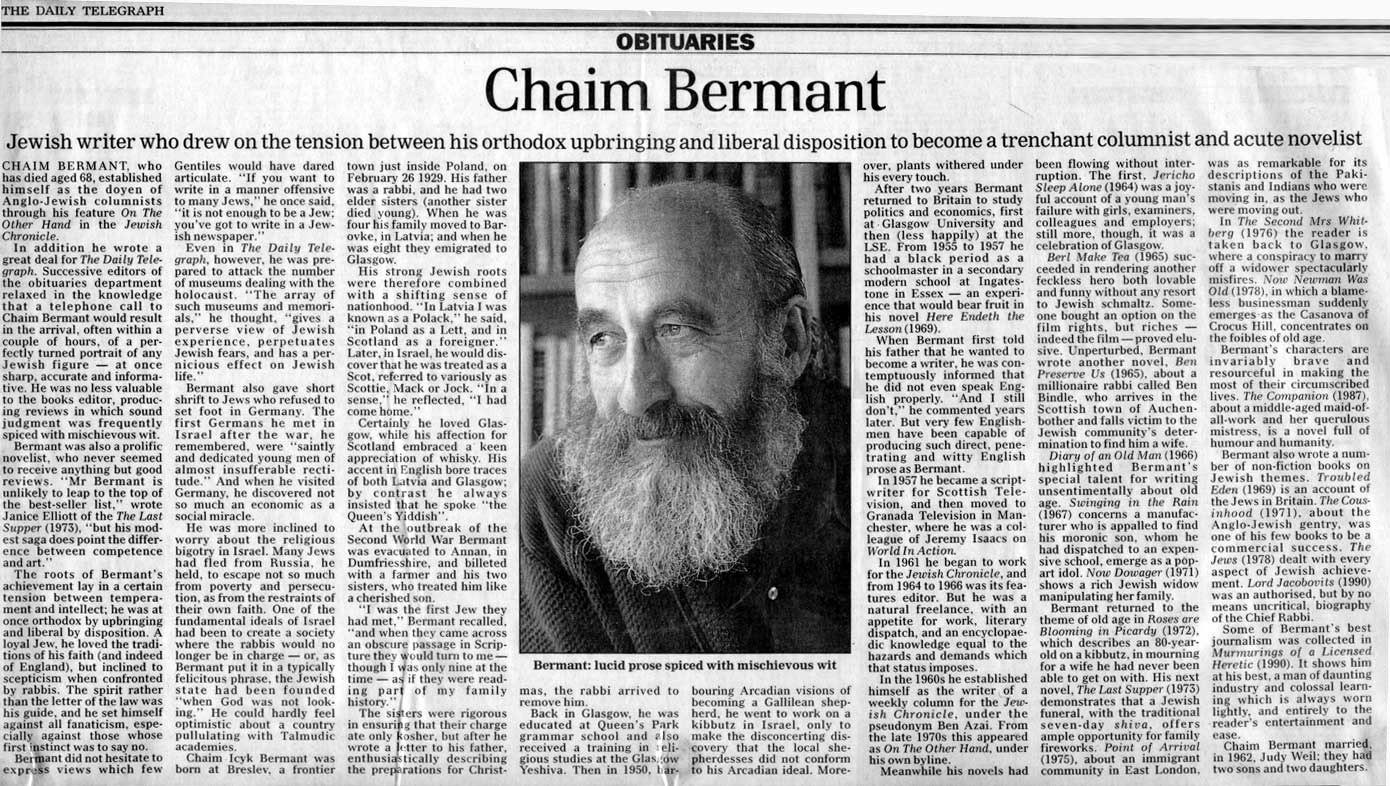
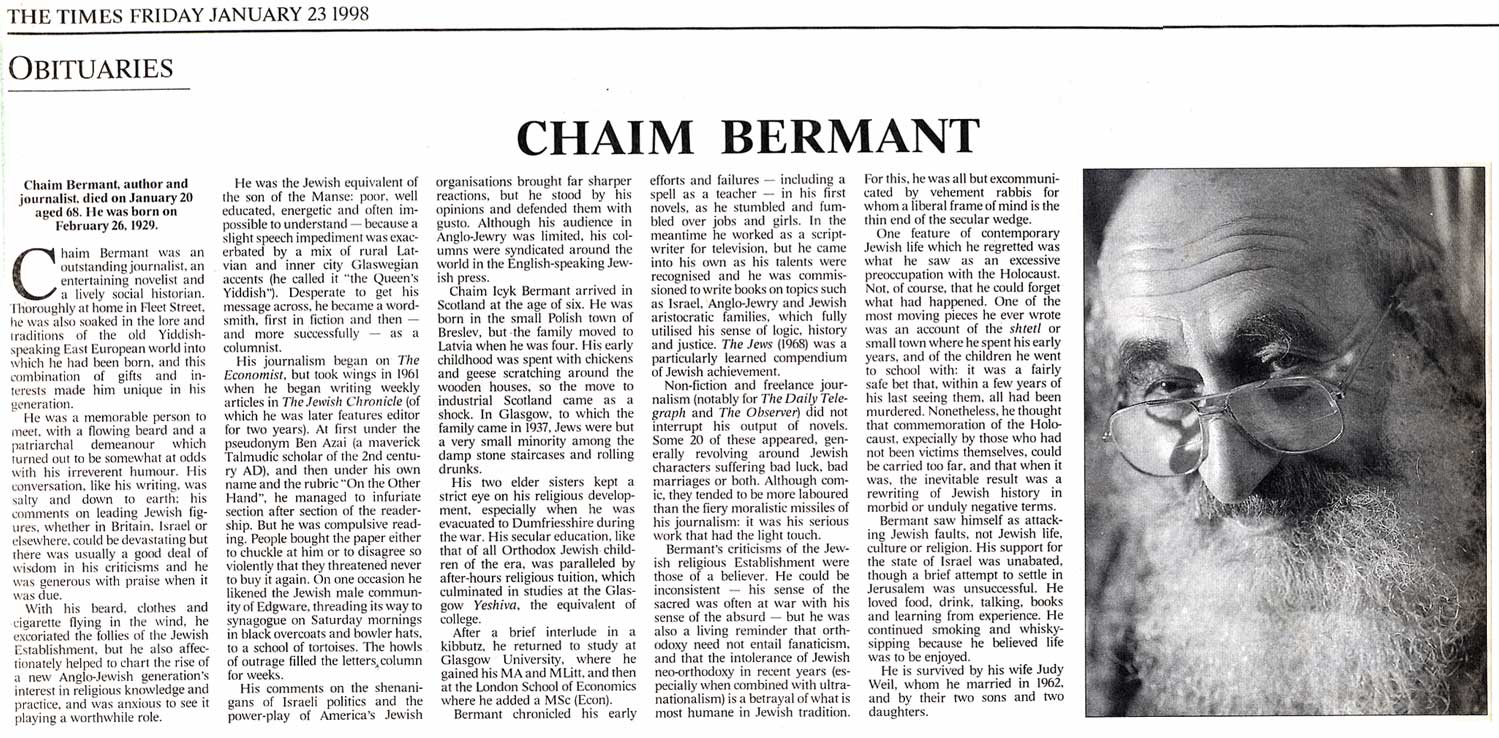
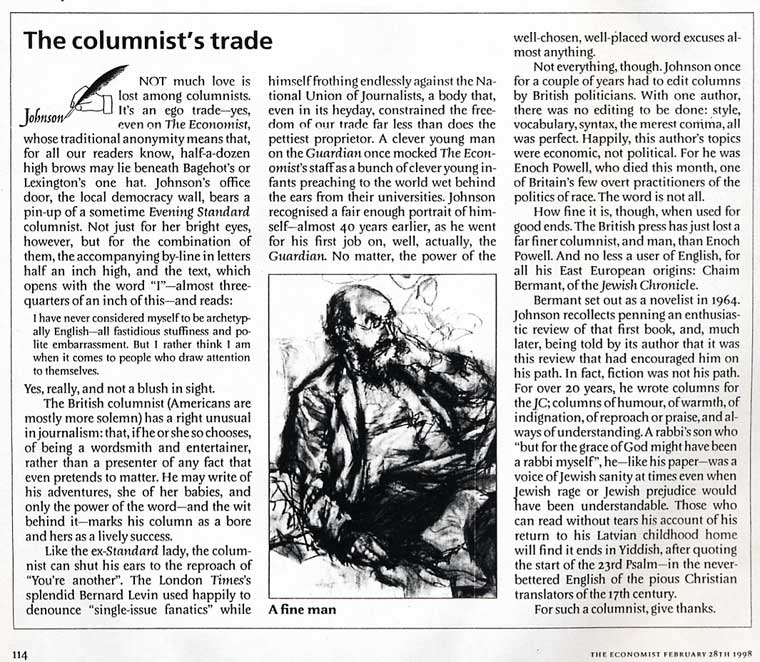
Shmarya was correct in the Protocols comments section: my late father in law, Chaim Bermant, was a columnist for the JC for almost 40 years. Indeed, he was their star columnist and a virtual British Jewish institution, whose name was perhaps better known than almost any other British Jew (as my husband once said, the most miserable looking people at his funeral were the JC publishers, who realized that their sales were about to drop). It would have been interesting for you to write about him in your journalism book as he was, imho, the rare embodiment of all the qualities you find so lacking in Jewish journalism today. He was witty, engaging, and always amusing, attacked hypocrisy wherever he saw it in the Jewish community and always pursued justice, qualities which made him very controversial in some circles. The bain of his life, I believe he once said, were the JC's lawyers who censored him because of British libel laws. As a result, he was alternately loved and loathed by British Jewry (who all enjoyed reading his articles nonetheless). You may find it
interesting to read some of the obituaries written about him (links below): how many writers in Jewish newspapers today would get obits in the national press?
The Guardian
Daily Telegraph
The London Times
The Economist
Cecile du Bois Says I Should Propose
Cecile du Bois, Cathy Seipp's 15yo daughter, calls: "Hey Luke. My mom and I were discussing weddings. And um..."
Cathy speaks up.
Cecile: "OK, maybe I was discussing weddings because I miss going to many weddings. I was thinking that of all the people we know, you seem to be the one most likely to get married next. Could you do us a favor and propose to your girlfriend. I know it sounds crazy but she likes you a lot. She's pretty. She's young. She's fertile. She could easily be Jewish. I think you should propose to her. That way we could go to your wedding because I miss going to weddings. Ok. Happy Thanksgiving. Bye."
'A Peppermint Tea, Please'
I was hanging out at Starbucks with a friend. I ordered a Peppermint tea (only $1:20). He made fun of me. Said my order was gay.
So I'm looking at my own Peppermint Tea package at home and its description reminds me of myself: "Delicately fruity and refreshingly aromatic, Peppermint is superb after meals."
My Deepest Darkest Fantasies
In shul Friday night, I rubbed my siddur (prayer book) and made three wishes:
* A franchise quarterback for the Dallas Cowboys.
* That Steven Weiss would just give me Protocols so I could do justly, love mercy and walk humbly with my God.
* That I could marry a woman who had the:
- Looks of Susannah Heschel
- The long black hair of Jerusalem Post Washington correspondent Janine Zacharia
- The midot of Chayyei Sarah
- The literary sensitivity of Alana Newhouse
- The razor wit and no-nonsense approach of Cathy Seipp
- The cuteness of J.J. Goldberg (Forward editor)
- The fertility of rebbetzin Tziporah Heller (15 kids)
- The gourmet skills of Rob Eshman (Jewish Journal editor)
- The voice of Leslie Katz (former SF Jewish paper reporter)
- The bouyant personality of Lisa On The Face
- The submissiveness of Forward reporter Eve Kessler
- The running ability of Julius Jones (150 yards Thursday against Chicago, yeah!)
- The sexual drive of Malcolm Hoenlein (who told reporter Walter Ruby, "If you publish this story, I will f--- you for the rest of your life")
I also wished for some other characteristics of my future wife but modesty prevents me from listing them here.
Anyway, if you are such a woman as this, or pretty close to it (I'm willing to compromise in some things, hit me up now because I'm going fast, I'm getting worn down to a frazzle by these Hittite priestesses).
Jewish Links
Lubavitch putsch in Vilna exposed
............
David Klinghoffer fluffs the most overrated Jewish scholar -- Jacob Neusner. Neusner is a nasty man who harvests the work of his grad students to list himself as an author on 909 books. Elite students in his areas who decide to go to other academic graduate programs than Neusner's have often found Neusner trying to destroy their careers.
I've tackled a dozen of Neusner's books. The reward divided by effort ratio was low.
Shmarya writes: "Neusner taught at Minnesota as a visiting scholar for a quarter or two. He was so hated by many of his students that they started a petition drive to have him removed early. He's done some important work, but he's a very difficult person."
Reb Yudel writes:
Note that Klinghoffer essentially omits the last 30 years -- and 950 books -- of Neusner's career.
The nastiness is such that at a recent academic conference on Talmud at NYU, Daniel Boyarin had to apologize for acknowledging Neusner's work.
If you want a good, solid translation of Neusner into English, check out the latter third of "Surpassing Wonder: The Invention of the Bibles and the Talmuds."
..............
Pinkas: US Jewry must focus on local Jewish education
.............
My latest book reviews:
The Cambridge Companion to Jewish American Literature: B
Autum of the Moguls by Michael Wolff: B
ESPN Sports Century: B
The Franchise: A History of Sports Illustrated Magazine: A
Lonesome Dove: A
.............
Intimidating Women Who Complain About Rabbi Mordecai Tendler
A couple of letters from rabbi Mordecai Tendler's lawyer during 2003:
August 4, 2003
From the law offices of Bradley J. Rephen, P.C.
17 Squadron Blvd., Suite 320
New City NY 10956
845-678-1278
Dear Ms. [name deleted in my copy]
At the outset, please be advised that this office has been recently retained by Rav Mordecai Tendler and Kehillat New Hempstead.
It has come to our attention, by reliable third-party source(s), that you were among a small group of individuals that composed and/or promoted a certain letter detailing maliciously fictionalized allegations against Rav Mordecai Tendler and/or Kehillat New Hempstead.
Aware now of the vicious nature of your plenary defamatory campaign and your cowardly attempt to assume the veil of anonymity, please be advised that we are firmly insisting that you:
(i) Cease and desist from any further libelous and slanderous conduct referencing Rabbi Tendler;
(ii) Prepare a list of recipients of the aforementioned letter;
(iii) Coordinate with the undersigned a letter rescinding and retracting the defamatory allegations; and,
(iv) Cease and desist from the fraudulent and unauthorized use of the Kehillat New Hempstead name.
Note that if we do not get confirmation of the above within seven (7) days from the date of this correspondence, both Rabbi Tendler and Kehillat New Hempstead will pursue all the proper avenues to achieve the requisite recovery/restitution.
As a side note, in response to the willful and harmful nature of your labors, Rabbi Tendler and/or Kehillat New Hempstead are in the process of coordinating with the county's District Attorney's office the filing of a criminal harassment complaint to prevent further felonious assaults.
..........
October 20, 2003
To: Ezra Glaser, Esq.
From: Bradley J. Rephen
Please be advised that this Law Firm no longer represents Rabbi Mordecai Tendler and Kehillat New Hempstead. All communications should be directed to Rabbi Tendler and/or the Board of Directors of Kehillat New Hempstead.
Curse The Darkness
I emailed Phil Jacobs, editor of the Baltimore Jewish Times, a couple of weeks ago, about 15-hours before posting about him and his coverage of rabbi Eliezer Eisgrau, the head of the Torah Institute of Baltimore.
Phil couldn't be bothered to reply to my email but he has inordinate energy to complain about me to numerous people. You'd think that if he was a man about these things, he'd call me up and talk to me. But I guess it is easier for him to curse the darkness rather than to light a candle and pick up the phone.
Jewish Links
Melchior launches new social action movement
The Coalition for Justice in the Hawaiin Gardens and Jerusalem
Rav Mordecai Elon, head of Yeshivat HaKotel
The name of the Lubavitcher rebbetzin
Knesset panel okays penal code change giving minors who were sexually abused until age of 28 to press charges.
The return of Yori Yanover's USA Jewish. He used to write the best daily compendium of Jewish news.
Shmarya writes:
Simcha has this post on the rape of Dinah. Note that he focuses on SOCIETAL CONFORMITY, and the need to follow rules.
I posted this in response:
The story seems to be teaching that the shame associated with abuse makes it difficult for the abused to do things – like leave Shechem – that acknowledge the abuse. Many if not the vast majority of abuse victims feel responsible for the abuse and blame themselves, not the abuser. Dina seems to have been paralyzed by shame. A proof of this is a midrash that notes that, after Shechem had been killed and the town routed, Dina refused to leave with Levi and Shimon. She only left after Shimon promised to marry her. What amazes me is the way rabbis seem to miss the major point of the incident, and concentrate instead on the midrashim that focus on what Dina did to 'cause' the rape. Worse yet, this clear lesson on the psychology of abuse is lost on these rabbis, rabbis who, at least in theory, may be called upon to poskin for and counsel the abused. Think of the rabbinic response to Lanner's victims, for example.
Shmarya | Homepage | 11.24.04 - 12:25 pm | #
And then, this:
Shmarya: "What amazes me is the way rabbis seem to miss the major point of the incident..."
Simcha: "1. You mean like the rabbis who wrote the midrash you just quoted?"
No. I "mean like" many of the rabbis who teach at YU, with one particular rabbi first in my thoughts, along with most of the rabbis of the haredi world.
Shmarya | Homepage | 11.24.04 - 1:53 pm | #
Simcha then responds:
No. I "mean like" many of the rabbis who teach at YU, with one particular rabbi first in my thoughts, along with most of the rabbis of the haredi world.
It's easy to condemn people you've never met and know almost nothing about. Do it elsewhere because from where I'm standing, he's miles above you in every possible way.
Simcha | Email | Homepage | 11.24.04 - 2:03 pm | #
I then wrote, "Tell that to Lanner's victims" and also noted that my criticism extended to "the former leaders of NCSY and the OU, except for Dr. Granchrow." I did not name any rabbis.
Simcha deleted the comment.
Keep in mind that Simcha is very close to Rabbi Mordechai Willig, who, if you recall, covered up for Lanner and verbally attacked at least one of Lanner's victims. Much later and under tremendous pressure, Rabbi Willig apologized. Lately, as you have heard, R. Willig has been critical of R. Blau's involvement with the Awareness Center. While I too have serious questions about how the Awareness Center is functioning, for R. Willig – with his record of covering for Lanner and his apparent inaction on the issues related to abuse in the Orthodox community – to criticize R. Blau without offering any solution to the problem is a tremendous chutzpah.
What's wrong with YU? Just that.
Polin goes too far. But with leaders like R. Willig, Orthodoxy provides no alternative to her. And, as always, it's the victims and those falsely accused who suffer for it.
Jeanette Friedman writes:
I am trying to collect as many emails of survivors and their descendants as humanly possible, and they need to be sent to the [email protected].
An important survivor, who was impoverished by nasty circumstances, died last week because he didn't have proper health care. We want to start a campaign to channel survivor funds to the survivors, and we need to do it via email, because we can't afford any other way of doing it.
Could you please post a notice that all computer literate survivors and their descendants are to please send their email addresses to the above email address? Here's what I sent out to my friends and colleagues:
After we learned how terribly Fred Diament, z"l, died last week, there were discussions with Holocaust survivor leaders in the U.S. and Israel, the American Gathering of Jewish Holocaust Survivors in NY and the Association of Holocaust Survivors' Organizations in Israel (Roman Kent, Noah Flug and others). These leaders are starting a campaign to mobilize the grassroots on health care issues for survivors.
All computer literate survivors, 2Gs, 3Gs and even 4Gs are asked to send their email addresses and those of any descendants and survivors that they know to [email protected] so these organizations can save thousands upon thousands of dollars in snail mail costs, money the American Gathering and the Israeli survivor organizations do not have.
Fred's call for better health care for dying survivors will not be ignored, so that we will try to prevent any other survivors from dying as ignominiously as he did. May his untimely and unecessary death not be in vain.
The Sex Abuse Case Against Rabbi Mordecai Tendler
I understand the RCA wants to re-interview many of the survivors and interview new survivors. I hear that the RCA believes that the Praesidium private investigators (Joan Hickerson) report on Tendler won't be sufficient to boot him from the RCA. Tendler has assembled a formidable legal team that is adept at describing the women who accuse Tendler as crazies, drug addicts, etc.
I notice the similarities between the way the cases in Baltimore and Monsey are being handled. Does Mordecai Tendler have ties to Ner Israel?
A legal letter relating to this case Part Two Another letter
Larry Yudelson aka Reb Yudel writes:
There you go, Luke, burying the lede.... and coming close to slandering a law firm, to boot.
You mean to say that Tendler has assembled a second legal team, after his first counsel lasted only two months.
Followup questions: Did the women in question do as demanded when they received the nastygram?
Were charges filed by the DA's office, as promised?
Is the answer to that question connected to the change in legal representation?
And who is the new legal team?
What are the limits to the use of discretionary funds? I would imagine there are ample court precedents to answer that question.
Here's a letter that was sent out in the summer of 2003 about rabbi Mordecai Tendler:
To Whom It May Concern:
We are a group of rabbis, mental health professionals, and physicians coming from a wide range of religious observance within the Orthodox world, who are very concerned about a serious situation in your community.
This is a letter to warn you to protect your daughters, wives, and other vulnerable women in the community from a very dangerous rabbi. This rabbi wears the clothes and publicly acts out the role of a very devout Orthodox Jew, presiding at levayas and simchos, answering halachic shailos, counseling individuals and families, abut in private has had numerous sexual affairs with many women - vulnerable, distraught, battered or emotionally disturbed women who had unknowingly come to him for counseling and guidance, for kiruv, or to learn more about Yiddishkeit. These women do not know each other, but doctors, psychiatrists, psychotherapists, as well a many rabbis in our community and even gedolim in Eretz Yisrael know who they are - for these women each sought their counsel as they were severely traumatized by having a sexual involvement with a rabbi of this stature - often in his study while his wife and children sleep or were not at home, and often while other women waited outside his office. Both married and single women, and even teenage girls have been stalked or propositioned, then were threatened and intimidated if they came forward.
There is a growing concerted effort by community rabbis, gedolim, professionals and lay people in the community who know or who have become involved with helping these women to prevent future occurrences. Many shul members have left or are moving away. There are many who know but are afraid to act, because others who did were threatened. This rabbi even paid a large sum of money to one of the women to be quiet, because she had a lot taped and written pieces of evidence and was "talking to much," but there is mounting evidence that cannot be discounted, and many more reliable and credible witnesses to these incidences are surfacing.
Because of this rabbi's heinous actions, there are people who have gone off the derech, marriages have been destroyed, weddings canceled. Some victims were so traumatized that they needed to be hospitalized. Many of the rabbonim in the area meet periodically to discuss this terrible problem within our midst. And are doing extensive research and compiling the evidence into a large written report, and are in consultation with gedolim in Eretz Yisroel. They have stated that it is a matter of pikuach nefesh to inform you of this problem, and is therefore not in the category of Lashon Hora.
We must protect the women in the community from the sick and evil behavior of this man who is himself a rabbi. His name is Mordecai Tendler. He continues to deny the allegations despite the mounting evidence that confronts him. But not only is he denying it, but he has gone to great lengths to cover up his tracks with lies, threats and pay-offs. Your shul must find a way to force this man to step down from his position as a community rabbi, and he must be pressured into seeking treatment. This should be done expeditiously ass we are trying to prevent certain outraged individuals from taking these stories to the Jewish Week, or even worst, more secular media, which would be a terrible Chilul Hashem, and would be even more hurtful to his poor family-although would be a worse Chilul Hashem to allow him to continue to harm more women and their families.
Do your own research! Speak to some of the other rabbis in the area, as well as some of the people who have left the shul - and therapists and doctors in the Monsey area, as well as in Brooklyn, Manhattan and even Israel. Not everyone in the Monsey area knows about this yet, but many do so don't stop your investigation with just one person who might have limited or no knowledge of this horrific situation.
The following was sent out to threaten those who were agitating against rabbi Mordecai Tendler:
To whom it may concern:
There is a great danger in our community that has no bounds to the potential harm that has been caused and may be caused in the future.
There are two women who present themselves as "mid-wives". They encourage those that are economically struggling that there is an alternative to the traditional safe and sterile environment of a hospital to deliver a baby they have solicited business among those that are desperate and believe they have no choices. They have lied, mislead, deceived and endangered those that were unfortunate enough to believe them. The results have been devastating.
On many occasions the environment where they delivered a child was not correctly sanitized or sterilized. Such carelessness has lead to infections and complications for both the mother and newborn child. On other occasions the instruments used by these "mid-wives" were not properly sterilized from the previous births. These unclean instruments caused additional infections and complications.
Further harm has been caused by their questionable skill level and failure to continue their training beyond the minimum level required for certification. Their "delivery room" has failed inspection by the State of New York on two occasions in the last six months. Despite all of this, these women continue to practice their witchcraft totally unsupervised and accountable to no one.
These women are _________ and __________. They must be stopped.
Please spread the word to all that there is a great danger to those that rely on _______ and _______. the lives of both the mothers and newborn children are at risk. Help us save lives. Stop _____________ and _____________.
Sex Abuse In Baltimore
Judah writes:
There is no such thing as "just a little" abuse. Hopfer seems to be insinuating that therapists or friends of a survivor of child abuse would somehow convince them that they are broken beyond repair. He is telling us that people convincing someone that they are damaged is what causes the damage, and not the abuse itself. This is a warped idea that Hopfer and others in the frum community latch onto to
try to deny allegations that they don't want to believe. The feeling of being damaged is common to survivors. Therapists and other helping proffesionals generally try to help survivors get beyond this awful feeling. Minimizing abuse by calling it "inappropriate behavior" also does not help.
In his little damage control shul talk on Sunday R' Hopfer did not address the important issue of how to help survivors who are abused withing the community to heal. He did not tell people to cooperate with an investigation even if the investigator is not from within the community. He did not say exactly who receives and investigates allegations of abuse and how they are dealt with. He was simpley doing damage control for Eisgrau. He was trying to give the message to his community that they should not worry. That he has everything under control. Hopfer also said that there have been false accusations. How does he know this? What credentials and training does he have to be dealing with these issues and recognizing which allegations are true or false? False allegations of abuse are actually very rare, much more so then true allegations of abuse. As far as the "professionals" that "help" with these investigations. They are all members of the Baltimore community and have conflict of interests. For example Aviva Weisbord, clinical psychologist, sister of Matis Weinberg. Friend of Eliezer Eisgrau. How much should her tainted opinion that Eisgrau is count? Wake up Baltimore! You have a problem.
Spirituality, Sexuality, and How Survivors of Childhood Sexual Abuse Experience God
© (2004) By Vicki Polin, MA, LCPC, Michael J. Salamon, Ph.D., and Na'ama Yehuda, MSC, SLP, TSHH
Spirituality and Sexuality are very often confusing issues for adult survivors of childhood sexual abuse, and for several valid reasons. In families where the concept of God is present, a child's first representation of God is either of their parents or through their parents. If you have loving, kind parents you may develop a view of God that is loving and kind. If, however, you grew up in a family of violence your perception of a higher power would be of a being that is controlling, explosive and violent. For children who have been sexually violated by their parents, their role model for God is that of a sex offender. Survivors' internalize a view of a punishing, abusive God, who only allows bad things to happen to them because "God loves them." They live in a place where nothing is safe, not even their thoughts, because God can read those and therefore punished for even feeling angry, upset or disrespectful. Given the way children develop a perception of the world, a survivor of the heinous crime of incest would naturally question the veracity of a kind, loving God.
The Talmud (Moad Katan, 17a) relates that a respected Rabbinical educator was rumored to have been involved in behavior that was "hateful." The commentators suggest that he was either an adulterer or seduced young women. The Rabbis ostracized this individual. Unfortunately, despite this tradition to ostracize such offenders, Jewish communities have not taken such a strong, responsible position toward molesters. Too often when allegations of child molestation are brought to the attention of community leaders, parents or relatives of victim's are reminded that discussing issues of molestation within the community or bringing these types of allegations to the public would result in any number of negative outcomes for the survivor. These consequences include difficulty finding a marital partner of substance for not only the survivor, but also other family members, or could result in the survivor or family members of survivors not getting into good yeshivas (schools). There are tales of families of abuse victims of having to relocate to another town as a result of the political pressures following disclosures. Not only does the survivor have to struggle with their trust and belief in God so does the survivor's family.
We have begun to discuss the possibility of a correlation between assimilation and childhood sexual abuse. According to the most recently available data one in every three to five women, and one out of every five to seven men, have been sexually abused by their 18th birthday. As part of the healing journey, the majority of survivors of abuse reach the point where they try to integrate what happened to them on a spiritual level. Many are in twelve-step programs, surrounded by individuals of other faiths, yet the Jewish survivors often feel different. Jews have very different customs then that of their Christian friends. When a survivor is from an unaffiliated background, they may feel at a loss -- unsure of what to do, or how to do it while survivors from backgrounds that were more traditional and included a Jewish education may feel betrayed by that background. The confusion of the healing process adds to the inability to find a healthy spiritual place within their own religion. So what is a Jewish survivor of childhood abuse to do?
Up until now there have been very few individuals who are "survivor friendly" in the Jewish community. We need to start opening our minds and our hearts to begin listening to survivors of childhood sexual abuse bearing witness. Just like holocaust survivors, who were initially shunned, survivors of childhood abuse need to be allowed to speak in order to heal, to be able to learn to connect with God, to see God as something other then neglectful, abusive and cruel. Those listening to these disclosures have a responsibility to themselves, their families and to the survivors. It is vitally important to make sure they have access to a support group conducted by a trained facilitator who is experienced with compassion fatigue (secondary post-traumatic stress disorder), so they are allowed to debrief and maintain balance, after hearing the voices of survivors.
Karen is a thirty-year-old survivor of childhood sexual abuse. She indicated that she spent her life trying to connect to something that was spiritual, yet felt she was failing. Over the years she approached many rabbis asking them questions. Unfortunately, the Rabbis, due to a lack of training, were unable to help her understand either her questions or the concepts with which she need the most help. Most had difficulty listening to her disclose her abuse history. When Karen was a child, while her father was molesting her, he would say "this is how you know God loves you . . . you know anything that feels this good has to have come from God . . . this is how you know God is inside you." Knowing this information would be critical in understanding Karen's difficulties with the concept of God. Yet most Rabbis doing outreach were unable to help her reframe her experience and make it possible for Karen to learn to connect.
Rivka was in her teens when she first disclosed to a friend that her father, a rabbi was molesting her. Her father was also a principal of a school for young boys. Her friend told her mother, who in turn, went to a local community leader to ask for advice. Because of the stature of her father, the community leader suggested they keep quiet about the abuse. As time went on, Rivka was unable to cope. As a teen she ran into some difficulties and ended up moving into the home of one of her classmates. Due to political pressure within the community, the family that Rivka resided with was asked not to daven (pray) in the synagogue they had been members of for years. The family was dedicated to helping Rivka heal, and were not about to put her out on the streets. Rivka eventually went to college, was able to support herself financially, got married and is the mother of three. Rivka came from a Torah observant upbringing, but from her experiences with the denial of the community, she no longer practices. She feels betrayed by her family, the Jewish community, and most importantly by God. When speaking to community leaders of the town she was from, and when her name is mentioned, they make comments such as she's happy, she is married and has children. But they are not completely correct. Rivka's is in mourning. She misses her biological family, she misses her connection to her community and she feels that has no one to talk to about her feelings about God.
Mitch grew up in family filled with physical and sexual violence. The family belonged to a synagogue and his parents made sure to enroll all their children in programs so that they could learn about Judaism. There was a problem -- Mitch was deaf. None of the Jewish educational programs had interpreters. Mitch was not proficient at lip reading and disclosed that he was bored and felt left out. Growing up Mitch never felt that he was a part of his family since the majority of his family members were not proficient in sign language. He was alone isolated in his deaf world.
School was Mitch's only respite. He was enrolled in a school for the deaf, and could communicate freely with people who could understand and relate to him. Growing up in the South and being deaf meant that he didn't have any Jewish friends. As he reached high school, he wanted to be like his friends. Most of them went to church. Mitch had no concept of God, and was like a sponge to learn, to connect to something spiritual. Mitch's concept of God was that of a father who was filled with anger and rage. No one in the Jewish community ever took the time to meet Mitch's needs. He never was given the opportunity to express his thoughts and feelings about his concepts of God to anyone Jewish. But then the missionaries reached him. Like so many survivors, the desire to feel loved was strong. His new friends knew this and showed him unconditional love. He would do anything to feel loved and cared for, and if it meant learning about another religion, then he did it. When his family realized what was happening they tried to rectify the situation, but again it was done in a way that appeared to be an attempt to control and abuse him. Their attempt was unsuccessful. To this day Mitch's views Judaism as something that is abusive and wrong.
The more our communities, and our leaders are educated on the issues relating to childhood sexual abuse the easier it will be to help heal the oozing wounds of childhood sexual abuse. Band-Aids can only cover up an infection. Our communities need to do major wound care, some individuals may require "spiritual surgery," while others my just need a topical ointment. But together as a community, as a people we can come together and heal the world.
Willy Wonka Golden Tickets Come to Belz
Belzer Hassidm have one of the biggest shuls on earth. This behemouth is located in Kiryat Belz--the Belz colony, in Jerusalem.
The Shul is pimped out. The paroches on the aron is made of woven gold, intricate carvings adorn the ark, and the mikve has as many flavors of heat as one could possibly imagine.
To pay for all this pimpage, the Belzers raised a lot of money from their adherents all around the globe. They also sold seats to important donors, even donors living in faraway Boro Park.
When you buy a seat in Belz, the give you a gold leaf certificate. It has a painting of the shul on it. You get a seat (needless to say) in a stunningly gorgoeous shul.
In spirituality, its all about the benjamins (and the Rokeachs) and you get what you pay for.
Rabbi Hopfer Addresses Sex Abuse In Baltimore's Orthodox Community
Rabbi Yaakov Hopfer, one of Baltimore's two most important Orthodox rabbis, spoke about the whole issue (no names of course) of rabbinic sex abuse on Sunday morning in shul (it was taped and widely distributed).
It was a Q&A session with the rov. Rabbi Hopfer knows his name has popped up repeatedly on the Internet [Protocols] in connection with Orthodoxy's handling of the string of sex abuse cases in town.
Rabbi Hopfer brought up the issue of sex abuse. How it's a real problem, taking place too prevalently. (Someone asked him how prevalent it was. He answered "too prevalent".) How every claim has to be investigated and that nobody should be turned away and not believed. How he has dealt with a number of cases. How victims have come to him. etc. He also added that an accusation is not a conviction. he knows of false accusations made by people.
Rabbi Hopfer said the community rabbis are aware of the problem and that investigations are being done behind the scenes.
Someone in the audience spoke up: said he's a teacher in one of the local prestigious public school boards, and that in the public school system there is a system that investigates things quietly too.
Rabbi Hopfer recognizes that they don't want to ruin innocent lives by exposing someone who is only accused.
Someone in the audience asked if three people make accusations about one teacher to three different rabbis or principals, does it ever centralize? He said that it does. He said that he didn't want to name names in public (and on tape), but the accusations do usually reach the same people in the community who take them seriously and investigate.
Rabbi Hopfer is not a smooth political operator. He is a soft-spoken, mildly stuttering giant of a talmid chochom. The other big rabbi in town -- rabbi Heineman -- seems to be more of an operator.
Rabbi Hopfer did add that not all "abuse" is worth all the destruction. He seemd to recognize a category of inappropriate behavior that did not warrant destroying a child's life by convincing the child that s/he's damaged and broken/irreparable.
He said that every yeshiva and day school in Baltimore has precautions in place and a system of dealing with accusations.
He said that some communities have taken extreme measures. e.g. In LA he said that the yeshiva/day school educators have come to a consensus never to touch any students, in any way. He (and an audience member) aknowledged that that may be too harsh, since often children need physical affection (eg a hug). R. Hopfer says that he knows that he takes a chance every time he hugs a kid, but that he feels the risk is worth it because the child needs it.
He mentioned how much more dangerous accusations are nowadays, because as soon as someone is accused, it can be on the Internet within minutes.
I think it's clear that the Eliezer Eisgrau case was brought to his attention, investigated under his auspices, and he concluded that it was false.
Chatting About Miscegenation
Cathy Seipp writes:
Lewis ran into Luke Ford Friday night at some University of Judaism event, where Luke was busy offending everyone with his usual opening conversational gambit -- going round the table and asking fellow guests how they feel about miscegenation.
Lewis: "I see no reason why a white woman shouldn't go out with you."
Mark writes: "I still recall talking with a black liberal woman, and she was so indignant about the thought of her daughter marrying a white guy. I think leftwing bigots are the worst of both worlds: they're into sloppy liberal ideas and politicans on one hand, and into the rigidity of over-the-top rightism (or KKK-type instincts) on the other."
Link writes: "So what is so terrible about starting a conversation on the topic of race-mixing? If the NFL can do it in primetime, then Luke can do it on his own time. Personally, I appreciate life as a full palate of colors. Mix them all together, and what's left? They must be kept separate if they are to be enjoyed, a fact not lost on the more artistically inclined amongst us."
How Jews Can Get Behind Gay Marriage
I am skeptical, but when Amalek speaks, I have no choice but to listen (really I don't). Read his intriguing ideas right here. Perhaps this really is the way aspiring Torah Jews like me can jump on that gay marriage bandwagon without sounding as gay as a democrat threatening to move to Canada.
Mine Eyes Weren't Watching God
I couldn't slog through this black-American classic by Zora Neale Hurston -- Their Eyes Were Watching God. I must be a racist because I also hated the novel The Color Purple.
Mystery Of Eduard Nektalov
He was also a Bukharan Jew. He came to the U.S. almost 30 years ago from the former Soviet republic of Uzbekistan. The Bukharans trace their history in Central Asia back almost 2,000 years. Most came here following the breakup of the Soviet Union, and almost all of them have settled in Rego Park and Forest Hills, where the Bukharan community, which consisted of fewer than twenty families during the seventies, now numbers nearly 60,000 people.
Murder of rabbi may have been 'criminally motivated'
Jeff Jacoby on God and hatred
WNBC - 42 students arrested from Joseph Kushner Hebrew Academy
Rabbi Baruch Lanner seeks new trial.
Neil Rubin gushes over Shoshana Cardin, the First Lady of Jewish Volunteers.
Book Review: Rescued from the Reich: How One of Hitler's Soldiers Saved the Lubavitcher Rebbe.
Shmarya writes:
Chabad had $5000 in the bank specifically earmarked for the Frierdiker Rebbe's rescue. They still did NOT pay the lawyer who arranged the rescue. Further, the Frierdiker Rebbe's files show clearly that he did NOT work on rescue for ALL Jews. He only worked on the rescue of a few of his students and yeshiva teachers, the Gerrer Rebbe, (some also say the Belzer Rebbe, but this is unclear), and the Frierdiker Rebbe's library (80 % secular books according to record), household effects, silver and JEWELRY – in fact, he spent much time and effort trying to
save his possessions while Jews were being slaughtered all around him.
After he got to America the Frierdiker Rebbe campaigned to start a Lubavitch yeshiva, even though there were other already-functioning yeshivot with Chabad students and the money required to open a Chabad yeshiva was desperately needed for rescue. He also started a Pidyon Shvuim/rescue fund and regularly advertized for donations. According to Rigg, most of the money went to the new Chabad Yeshiva, not to rescue.
He also refused to cooperate with Mike Tress and others who saved thousands of lives, and condemned the Rabbis March on Washington as a fruitless endevor that would never work. That march is credited with starting the War Refugee Board that saved more than 200,000 Jews from Hitler.
The Frierdiker Rebbe also started a Moshiach Campaign, arguing that the Allies would not be able to defeat Hitler, only G-d and his messiah would be able to do it. In that vein, he condemned emergency Shabbat appeals for rescue funds as being counterproductive – but again, Mike Tress and his coworkers saved thousands of Jews with those appeals, and did so with Rabbinic sanction.
I should also add that, in all the Frierdiker Rebbe's correspondence with high US Government officials, including President Roosevelt, the Frierdiker Rebbe never asked for Jews to be saved, for immigration quotas to be raised, or any other practical form of rescue. This is even more troubling because the Frierdiker Rebbe had been portrayed by Chabad as the Chief Rabbi of all the Orthodox Jews in the world (more than "3 million," in one document!), yet this 'chief rabbi' NEVER
pushed for rescue.
Chabad's record during this time is very troubling.
Overrun By Crickets
My hovel has been overrun by crickets. They're loud, embarrassing and creepy. They creep over my face when I'm resting. Aside from squashing them one by one, is there a way to get rid of them?
Funny Jokes About Dismemberment
Rabbi J. Hershy Worch writes: "I know where all the dismembered bodies went. I pulled out the veggie and crisper drawers from the bottom of my refrigerator. Eeeeewww!"
Funny guy. He makes the best jokes about dismembering people I've ever read. Comic geniuses have always been misunderstood and persecuted. Lenny Bruce. George Carlin. Hershy Worch.
How Mordecai Tendler Screwed Up The Teaching Of Rabbi Moshe Feinstein
Me writes:
This shabbos, I had a rare free 30 minutes of quiet. I sat down with my 2 copies of volume 7 of Igurot Moshe, which is a volume of tshuvot by Rav Moshe Feinstein, undoubtably one of the greatest Poskim of the last century.
These volumes are widely read and used by Poskim of our generation.
I've posted before how the original version of volume 7 (large over-sized)
differs from the newer Rabbi Mordechai Tendler re-edited version (smaller-sized book). I took 30 minutes to see how bad it was (I already knew from several Rabbonim).
As, the typesetting is similar, I was able to quickly find over a dozen alterations. None of which added anything to the tshuvot. If I was to extrapolate from the few pages I quickly inspected, I would have to estimate there are a lot of changes and alterations.
In some cases it is a mere unnecessary letter (in one case, gramatically wrong), a title change or an added quote of the source referred to. But most disturbingly I found a substantial alteration to an actual tshuva (page 180 bottom right column). I also found a paragraph added into the body of a tshuva praising Rabbi Mordechai Tendler (page 181 top right column).
Photo One
Photo Two
Photo Three
Photo Four
This is bad.
I fully understand why the Feinsteins have nothing to do with Rabbi Tendler.
What he has done to their grandfathers legacy is despicable. He has taken one of the great works of the last century and distorted it. It is a monument to the ego of Rabbi Mordechai Tendler and the impotence of this generations scholars.
It is not a subtle distortion. Take the 2 versions, sit down and compare. It's so obvious and plain to see. Does Rabbi Mordechai Tendler really expect us to believe his grandfather wanted to insert his praise of (Tendler) in an already published tshuva (that had no such praise)? It's clear what has been done.
It's also increadibly painful. How could this have been done and in such a
public way?
I understand that the Feinstein don't want to take family to a beis din. But
where are the Rabbonim of this generation? How could they allow this to be done to a gadol ha'dor's work? How could they associate with someone like Rabbi Mordechai Tendler who did this?
I implore people to contact the RCA and demand this issue be addressed by the Beis Din Ha'Kavod. The Rabbi Mordechai Tendler version needs to be removed from public circulation and Rav Feinstein's scholarship restored.
Steps must be taken to ensure a chilul like this never happens again to any of our scholars and that charlatons like Rabbi Mordechai Tendler are no longer tolerated or associated with.
This is what is allowed to happen to the work of one of our Gadols?
Where is the outrage?
Rabbi Porter Resigns
Vicki Polin of The Awareness Centerwrites: Rabbi Shlomo Porter has stepped down from the advisory board due to the fact he cannot take personal responsibility for the veracity and halachic conformity of all data listed on the website. He supports and wishes the Awareness Center great success.
Luke says: I think there might be more Orthodox rabbis resigning from TAC. They are concerned that it is not always run according to halacah (Jewish Law). Vicki Polin is an atheist and has more of a therapeutic and activist approach. She's an advocate for those she says are "survivors" of sexual abuse. Rabbis have to be concerned with not only advocating on behalf of "victims," but being fair to those accused, so their good name is not besmirched unfairly, and, above all, to operating according to halacah at all times. From Orthodox rabbis who've spoken to me of late, there's growing concern that TAC has gone too far, that it is operating a witch hunt against rabbis who are being accused on the flimsiest of evidence. They are concerned about "victims activists" (and they, to varying degrees place Polin in this category) who push women to come forward with accusations of sexual abuse that are based on hazy memories and tricky regressions (stuff that would not hold up in either a Beit Din or a secular court).
The Awareness Center is having a board meeting in early December. I expect that the Orthodox Jews on the board will demand that TAW be run according to halacah in every way or they will leave.
A Wedding Story
do you know about the halachos of marriage
like kiddushin and nisuin
kiddushin aka eirusin is the first part, which functions halachically as engagement, except its more binding than the kinds of engagements we have nowadays because although the couple doesnt live under one roof, she is considered an "eishes ish," i.e. someone's wife and all the laws that apply to how one must interact with a woman on the basis of her being married, i.e. that she's forbidden to anyone else, apply in the old days they used to to kiddushin/eirusin at a given time, and then wait a year or so for the girls family to gather a dowry and the husband to get a house and stuff then a while later they'd do the second half, nisuin, and then theyre fully married and move in together we stopped doing that around the time of all the eastern european pogroms because sometimes if people lived in different cities, the man would get killed or something but no one would ever know for sure that he was dead so the girl could never remarry. This is called an agunah.
Anyway so theres an old out of practice custom called "kiddushei kitana" which literally means betrothal of a minor
In generations past, a father was allowed to betrothe his daughter with kiddushin before the age of 12.5, to ensure that if anything happened to her she'd be taken care of and have a husband.
My friend was involved in a case of kiddushei kitana where a guy didn't want to give his wife a get (i.e. the wife was an agunah) and one of the things he used to blackmail her was he told her that he did this to their daughter but wouldnt tell them who he betrothed her to, i.e. the 11 year old daughter was an agunah as well
My friend died in the middle and i never followed what happened in the end.
Anyway the point of my story: I just saw on onlysimchas that the girl got engaged. So i guess everything worked out.
Vilna Siddur: The Official Siddur of the Intifada
With its crisp laser printed pages, extensive commentaries, and long essays on different liturgical oddities, it is not surprising that the Vilna Siddur is incredibly popular in the Yeshiva world. In the Lakewood and Chaim Berlin study halls, for instance, the Vilna is the most prominently featured and used siddur.
The Vilna siddur has a filthy, dirty little secret. The person who put it together was none Moshe Hirsch. Hirsch is a prominent Neturei Karta activist, the and a certifiable asshole. Though he put it out in his son's name, Hirsch did most or all of the legwork in writing the commentaries and scouring the prayers for the aforementioned liturgical oddities.
Hirsch is an asshole, don't use the Vilna siddur.
Shady Kashrut
Whats the deal with Rabbi Israel Steinberg? He certifies some of the coolest NYC resturants. Under his supervision are places like Dosa Hut and Udipi Palace in the "Curry Hill" section of (Murray Hill) Manhattan. He also supervises Buddha Bodi, a vegan place on the LES.
His fleishig offerings sound even better. Steinberg certifies Ben's Deli. Besides this mainstay of nonobservant LI Jews, he also certifies Dushnabe, the only Kajik place in the city, and Issyk-Kul, the only Krygyz resturant in the universe (I think).
People don't trust Steinberg's certification. Objections are raised because of Bishul Akum (the prohibition to have non-Jews cook for you) among other things. He is seen as some kind of charlatan, despite the fact that he was ordained in Torah VeDaas, and taught in Chaim Berlin.
I think Steinberg is a hero for certifying the coolest, most diverse and best resturants in NYC.
Stealing the Straps
The Israeli police have made a bust on a cache of stolen tefillin. Maybe there were some BDSM rabbis involved, and they needed the straps for their own purposes.
Yossi Klein Halevi Speech
After its two million dollar renovation, Bnai David Judea offers the worst acoustics of any synagogue in Los Angeles, along with the cutest security guards (Christians who vote Republican, while the shul leans 80-20 Democrat).
For those who could hear him, Yossi Klein Halevi was mesmerizing Saturday night. He delivered a 54-minute talk on the situation in Israel and then answered questions for 30-minutes (towards the end, near 10pm, the crowd was streaming out and at only half-strength).
I'm ready to heap even more plaudits on his head tonight than I was several months ago on this site when I nominated him for a Pulitzer prize in literature for his two memoirs.
I wouldn't even have gotten in the door tonight (due to the $18 price) except my buddy spotted me a free ticket (and bought a copy of my book to accompany him on his business travels).
Yossi spoke Friday night about Israel's turn to the East among those under 35. Those over 50 tend to look to Europe for vacations and culture. Those under 35 tend to fly to India after their service in the IDF (Israel Defense Force) to rejuvenate and explore their latent spirituality.
This has had many effects on young Israelis, including:
* They are more spiritually attuned and hungry than their secular elders.
* They are more open to ritual.
* They are less willing to buy into traditional schimatic mindsets (which have wracked Ashkenazim for almost 200 years).
* Though they are open to religion and to study of Jewish text, they are unlikely to automatically follow the dictates of Israeli's Orthodox rabbinate.
Yossi was equally eloquent Saturday morning, but that is a time in my life when I nap, and I couldn't fully break that habit today.
This was the first time I had seen Halevi in person. I wanted to spot some flaw in his character so I could bust his chops on my blog for not giving me an interview for my Jewish journalism book, but he was understated and charming (effective qualities for a journalist). There's no more sensitive observer of the Jewish soul.
His public speaking is not flashy or false. Just one thoughtful sentence follows another.
He got a crowd of over 300 people. One old man wandered in late. His earing aid wasn't turned on. The security guard inquired if he had a ticket. The old man started yelling that he was the president of this and that.
There's this amazing sense of entitlement among many Jews. They expect you to know who they are and their level of their accomplishment.
Yossi said:
Yassir Arafat has been indispensable for not only the Palestinians but for us...in telling us our place in the world. He's been a shadow prime minister of Israel for 40 years.
Arafat made clear to us that our great victory in 1967 would not lead to lasting peace.
Following the Yom Kippur war, Arafat started the deligitimization of Israel that is culminating now, two decades later.
In some sense, Arafat's greatest offense against Israel happened in the 1990s when he toyed with our deepest longings and seemed to offer us legitimacy, which we so desperately craved.
If Arafat is hated universally [in Israel] from left to right, Yossi Beilin said he would not go to his funeral...
Arafat represented the post-Holocaust legitimization of the murder of Jews and the delegitimization of the Jewish state.
Yossi supports Ariel Sharon. He says Sharon's approach to Israel's security is supported by at least 70% of the Israel public (support levels that no other Israeli politician could match). Yossi supports Israel's unilateral withdrawal from Gaza and the construction of a fence to keep terrorists. The fence would mean that Israel is going to retain sovereignty over greater Jerusalem. It means that every time Israel has offered the Palestinians an opportunity for a negotiated settlement (since 1947) and the Palestinians have spurned these overtures, the Palestinians are steadily being offered less and less.
Yossi says that only Israel's hawks can fulfill the vision of its doves. The left was right that Israel can't continue to occupy. The left was wrong in thinking that Israel could negotiate peace with the Palestinian leadership.
During question time, Yossi was asked about his last book (a journey seeking peace among Christians and Muslims near Jerusalem) and about his views on the threats posed by Iraq and Iran. He replied:
I don't believe that journey among Muslims has any relevance [to the current situation in Israel]. The book came out 9/11. I was in Manhattan waiting for my book party that night that never happened.
.......
I think back to two years ago and all the apocalyptic scenarios by critics of the coming war [against Iraq]. None of those came true. It is positive that Jihadists are concentrating in Iraq. It is proven in Fallujah that that war can be won. All that it requires is a deep breath and commitment.
I have no doubt that [Islamic terrorists] were disappointed that Bush was re-elected.
The re-election of Bush sends the signal to the Jihadist world [about America's determination to fight terrorism].
What I Think About Homosexuality and Sodomite Marriage
I normally don't like letting others express my opinions for me, but while reading the feedback section of Cathy Seipp's blog, I encountered writings of two correspondents who neatly summed up why I, and most similarly sane heterosexual men, will never be sympathetic to the cause of homosexuality.
First, one Christopher West wrote in:
"The bottom line in all discussions of gays and gay rights is this: most psychologically healthy heterosexual men will always view homosexuals with disgust. Oh, I know, gays like to view this revulsion as a fear, not disgust, and to that end they have settled on the word "homophobic" to describe this, but believe me, it's disgust, not fear (unless you have been raped by one of these in predator mode).
"But why should heterosexuals be disgusted with homosexuals? Because men naturally prefer life to sh--. The thrust of heterosexual sex is an activity that is responsible for virtually all complex life on earth. It's locus is the vagina, the portal through which passes all such life, and which therefore is sacred to mankind. Homosexual sex, on the other hand, has no reproductive component, and its locus is the anus/rectum, the portal through which passes all of life's sh--. Healthy men naturally prefer life to sh--, and healthy men naturally abhor men who lust after shit or activities that are apt to get sh-- all over their penises. What gay men do to other men is disgusting to most people and always will be, no matter that they be Christian or Jew or Muslim or Hindu or atheist; white or black or hispanic or chinese; liberal or conservative. Homosexual sex and the people who need it will always disgust the vast majority of the human race.
"Politically, I hope you keep gunning for acceptance as the full equals of heterosexuals. As a conservative white man, I know you won't get it, and it only serves to strengthen my political causes. But know this - you drama queen democrats will never win an election so long as you make gay fantasies part of your platform. They stink of sh--."
His views were buttressed by the comments of one "Mark:"
"Liberace, no less, was quoted once as saying he could understand why the physical behavior associated with male homosexuality made many people uncomfortable. I bet even quite a few liberals (including gays ones) in the back of their minds do go "bleech" when they think of male homosexuality OR, at the very least, the goofy androgynous aspects evident in some males and females----hell, some of the jokes in "Will and Grace" could be perceived as gay bashing. And, OK, Ellen Degenersis is gay, but does that mean she'd wilt and die if she had to wear less masculine clothing?
"How many parents---liberal ones included---will say, "Oh, look at our son Johnny going out on a date with the captain of the high school football team. We're so happy and proud!!" Or, "Look at our teenage daughter Susan smooching with the girl from next door. Isn't that adorable?!"
I think Christopher and Mark are spot-on. (And what word should take the place of "homophobia," to better describe the disgust - not fear - that most normal men feel towards homosexuality? I must ask my wordsmith friends.) It suffices to note that support for gay marriage is not to be found amongst ATJs (aspiring Torah Jews, which is what my Jewish swami in New York says I really am), Muslims, or honest Christians. And no heterosexual father looks at his infant son and dreams of seeing him someday standing in a church or mosque or temple, getting married to another man with sodomy on his mind. That's just how life is, and the sooner all you gay people acknowledge this, the faster the democratic party can get back on its feet and Hollywood can feel better about itself.
Great Movie - The Thief (1997)
The 1997 Russian movie The Thief is heartbreakingly great:
In 1946, a soldier fathers a child then dies before its birth. Jump to 1952: on a train, the child and his mother meet a handsome soldier who makes a play for her. She accepts. Posing as a married family, the soldier finds them a rooming house where he becomes everyone's favorite through his good looks and generosity. Meanwhile he gives the boy, Sanya, lessons in life: to fight back, to win at all costs. The child's mother, Katya, is head-over-heels in love with Tolyan, the soldier, but the relationship becomes rocky when Tolyan's true plans for the rooming house become clear. It starts them on a treadmill of flight that risks Katya's life, Tolyan's liberty, and Sanya's trust.
The Man Who Investigates The Rabbis
A Book To Change Your Life
Thursday evenings I like to kick back with a copy of the Hertz Chumash (commentary on the Torah), a copy of Rashi's Torah commentary and the latest Jewish Journal to read the views of one of LA's learned rabbis on this week's portion.
This change of season has made me feel out of sorts and I was blowing my nose and sorting fruitlessly through the pages of the Journal for the Torah column Thursday night, November 11. It wasn't there.
I was feeling quite upset when my phone rang. "Hi," said a breathy female voice. "I'm Jenny. Rob Eshman sent me as a constitutionally-protected act of literary satire that could not possibly be understood by an ordinary person as damaging to his reputation or that of the Jewish Journal."
"I understand," I said. "I'll be right out."
She was tall and blonde and naturally curvy. No surgeon's knife had touched her pure porcelain skin.
I brought her inside my hovel. She was wearing a long fur coat until she draped it over my pile of dirty clothes. Now she was dressed in the latest Victoria Secret fashions, including those black fishnet stockings and six-inch high heels I like so much.
"Rob said to give you this," she said, and handed me a note.
I unfolded it and read: "Luke, you have to question why your standard for true Jewish journalism is revelatory personal details. Yossi took you to task for this, correctly so. I'm all for including them when they are relevant, but to only be concerned for those kind of stories means you miss or demean very important communal stories that feature no sex or violence. For every kabbalah center or ecstasy investigative piece, we've done pieces like the recent one on the Federation's $20 million pension shortfall or the JCC's, pieces that affect many lives here but certainly are the opposite of sexy, and that make us no friends among the establishment. I like sex as much as the next guy, but I don't look to my community Jewish paper for a dependable source of titillation."
"Rob wants us to play a game called shmiros halashon (proper speech)," she said.
"But I really don't know Hebrew," I protested. "I just can't believe that Rob, who works for a reputable non-profit, could afford to send you. Are you sure it wasn't Malcolm Hoenlein?"
"Quite sure," she said. "Not Yossi Abramowitz either, though Yossi did give me these latest two issues of Shma for your perusal. Complimentary."
"Ahh, thank you." I took the journals and placed them on my book shelf near my Unlimited Power book by Tony Robbins.
"But Jenny, I'm sorry. I just don't feel myself this evening. I can't find rabbi Yatzoo's commentary on this week's Torah portion in the Journal."
"Rob's gotten rid of that and substituted a column on books that have changed one's life," she said.
I sneezed and blew my nose in one of the partially-used paper towels that dot my hovel.
"I've got a decongestant," said Jenny. She poured some white power on my desk next to my keyboard. "Snort that."
I bent over and inhaled through my nostrils. Immediately I felt better.
"I don't know Hebrew either," said Jenny. "In fact, I'm not even Jewish. My boss Nici doesn't usually get calls like this. I guess Rob's a weird one. But he tells me that you are a very naughty boy and I am supposed to reason with you. Do you take seriously Kant's categorical imperative? Do you always act in a way that if everybody did what you did, the world would be a good place?"
"My Torah commitments prohibit that," I said. "We don't hold with secular philosophy. Particularly not Germans. Nor wops nor shvartzes."
"Rob says that if we didn't feel comfortable with the Hebrew, we could study this English-language book Guard Your Tongue. We were to turn it into a game. One of us would read a commandment about proper speech and the other person has to name the source. If you get it wrong, you have to either drink a glass of Manischevitz or remove an article of clothing."
She produced a couple of bottles and sat down. We opened up the Chafetz Chaim and got down to it. Jenny's knowledge of Jewish text was practically non-existent and within an hour, she was thoroughly sloshed and highly vulnerable.
As I took her in my arms and carried her three feet to the one open spot on my floor, she breathed in my ear, "Rob wants you to be nicer to the Journal on your blogs."
I proceeded to fulfill her wish as she fulfilled mine.
Hollywood screenwriter Michael Tolkin reviews Philip Roth's new novel in the 11/12/04 Jewish Journal:
...George W. Bush is surrounded by a crowd who know that scientific creationism is superstition, but support him anyway. After all, their children get a private education based on science, not the public schools’ program of de-enlightenment. But they have sold their piety and conscience because he cut their taxes, or because they think he’s good for Israel — as though lowered taxes or chimerical support for Israel are worth the catastrophe in Iraq, the catastrophe in our drinking water, the catastrophe in public education or the catastrophe in the national debt. For this last catastrophe, his supporters are happily sacrificing their children and grandchildren by giving them the bill, and leaving them a future for this country that could look like Argentina without much more effort.
Robert J. Avrech writes about a book that changed his life when he was 12-years old: “The King’s Persons” by Joanne Greenberg. (Henry Holt, 1963).
Years ago, I complained that the Journal was not publishing a weekly commentary on the Torah portion. Now I agree with Rob Eshman's decision to replace that (the commentary was rarely illuminating and compelling) with a column on one book that has changed a person's life.
The Hebrew Kid and the Apache Maiden
A review of Robert J. Avrech's new book in The Ithica Journal:
My hands-down favorite book for middle school readers is "The Hebrew Kid and the Apache Maiden," by Robert J. Avrech. This is an adventure story, set in the 1870s. Ariel Isaacson and his family are taking the dangerous trip through the Arizona desert after they were chased out of a small town because they were Jewish.
All 13-year-old Ariel wants is to become a bar mitzvah boy, but first the family had to find a place to settle. They were warned by the cavalry that they were heading right into Apache territory, where the feared Victorio and his sister, Lozen, killed white settlers. But Ariel's father is both a rabbi and a mystic who believes in prayer and his dreams. When they do meet up with Victorio and Lozen, a magical friendship develops between Lozen and Ariel. But before Ariel can have his bar mitzvah, he encounters gun slinger Doc Holliday, a band of thugs who kidnap his sister and other characters unsavory and otherwise.
The dialog flows smoothly, the scenes are memorable; it's a terrific story filled with the best of Judaism ... and the surprising Apache culture.
Great New Parlor Game
A friend came over tonight and we played this Pirkei Arvos parlor game. One of us would recite a saying from the Mishna, and the other person would have to say the name of the rabbi. If we got it wrong, there was a penalty. My friend is not Jewish, so I cleaned up.
Jewish Politics Survey
Hal Steinberg ([email protected]) writes: I was referred to you by Roger Jacobs. I'm doing an ethnographic project called Los Angeles Judaism's Political Life. Roger told me that you have written a book on Jewish Journalism and that you might be able
to help me out with my project by giving me some contacts. I'm a college student at The Evergreen State College in Olympia, WA, but I'm from LA and here for the quarter doing my study. The project is a study into the voting patterns of Los Angeles Jews. In recent years there has been an increasing number of people who claim that the Jewish vote is changing, in particular becoming more conservative. The project
is studying whether this is true and if it is, why it is true. If you'd be able to help me with contacts I'd be very grateful.
Cathy Seipp Leaves City Beat
Cathy Seipp writes about her parting with leftist alt-weekly paper City Beat:
I don't know if it's my laissez faire attitude about disagreeable commenters, or my relationship with Luke Ford, or whatever, but people sometimes assume that I'll put up with anything. But actually, there is one thing I really cannot stand, and that's presumptiousness -- especially when accompanied by the added kick of unwarranted familiarity.
There's a disturbing amount of relish that Cathy takes in telling people to f--- off.
'No Chick Left Behind' Campaign Gathers Momentum
Zogby, Gallup, NYT/CBS and other pollsters note growing support for my "no chick left behind" dating campaign which should climax with Your Moral Leader firmly ensconced in the White House. Susan Sorrell writes:
I live in South Carolina and in the South, men call you "honey" and don't mean it as a pick up line. CreativeChick.com is my website....yes I am a woman (40 yrs. old) and don't mind being called a chick. (Unless you are a construction worker and are making rude comments.) I even have a blog, http://creativechick.blog-city.com , where I ramble on about my artwork, other artists, and stuff.
Loved the "no Chick Left behind" web log!!!
Three exclamation points! That means her comment is three-times as good.
Jewish Time Not So Amusing
I don't find "Jewish time" so amusing.
I arrived at 6:45pm to the West side branch of the Reform Wilshire Blvd Temple to take in a 7pm lecture by historian Jonathan Sarna. I owed him a copy of my new book, Yesterday's News Tomorrow.
I slip it to him while he's engaged in a conversation with two distinguished Jews. He holds my handshake and gives me his full attention for a minute. He talks about an article he'd read about my life. I was flattered.
The program began at 7:20pm. That is 20 minutes of theft from everybody who arrived on time. I have little patience for people who are five minutes late to appointments with me. Luckily I carry books with me everywhere so I don't waste this time. Still, I resent the theft.
There were three introductory speeches before Dr. Sarna took the stage. A bare-headed Harvey Fields (once the most highly paid rabbi in Los Angeles, about $300,000 annually counting allowances, until he stepped down a couple of years ago) gave a windy talk (read the whole thing) full of cliches and empty rhetoric about American Judaism's "magnificent history."
Rabbi Fields said that like most of the audience he was filled with worry for the future of America given Tuesday's elections.
The median age of the audience is about 60. Typical for a Reform crowd. A lot of old biddies with implausibly dyed hair.
As soon as rabbi Fields said about Dr. Sarna -- "he worked," I knew he would follow with the cliche "tirelessly," which he did.
I heard loud sighs around me as the rabbi wandered on.
Dr. Sarna takes the stage and immediately captivates with his energy and good humor. I'm disappointed that I've already heard many of his jokes. I've already read his book American Judaism. I fear the evening will be a waste, but Dr. Sarna pops in stuff I don't remember.
Peter Stuyvesent, the governor of New Amsterdam when Jews settled in the city in 1654, studied for the clergy in Holland until an incident with his landlady's daughter sent him fleeing back to the New World.
Dr. Sarna reads his speech but he knows it so well, and delivers it with so much energy and fun, that he holds my attention. He talks about Cohens coming to America and turning into Kerrys. "Remember him?"
I believe Dr. Sarna is a conservative, but I doubt that more than 1% of the audience knows that. Most of the crowd, I'm sure, assumes that any Jew who appears kind and decent is a liberal Democrat.
Dr. Sarna says that in 19th Century America, opponents of mixed seating called it promiscuous seating. Looking around at the crowd, I bet there's more action going on at an NCSY Shabbaton or a Stern College kiddish than here.
I'm hoping that Dr. Sarna winds up his speech with a hearty exhortation for Jews to have unprotected sex in hopes of replenishing our numbers (not that unprotected sex amongst 90% of tonight's crowd would result in anything more dramatic than a pulled muscle). Perhaps a bon mot from Chaim Amalek that hyper-educated Jewish women use their vaginas as toys while Palestinian women use their's as cannons. But no such luck.
During question time, an old woman rises and says all the Christian talk of the past election makes her nervous about American Judaism. If such Jews were truly nervous about such matters, they might try studying the Torah and observing the mitzvot as their Moral Leader does.
Dr. Sarna says culture is not an effective way of transmitting Jewishness over the generations. Religion is more effective. Yiddishism was one of the great failures of 20th Century American Jewish life.
He's asked about the vibrancy of American Orthodox Judaism. He says beware triumphalism from any of the denominations. We've seen Reform and Conservative triumphalism. Now we hear it from the Orthodox. But the Orthodox:
* Lose more of their young people than do Reform or Conservative (in percentage terms) because Orthodoxy is so hard and America so tempting
* Lose their best and brightest to Israel
* Fight amongst themselves
No Chick Left Behind
My new dating campaign is "no chick left behind. Let's study Torah together tonight."
The Teacher responds:
Luke, We all know how powerful a single word can be (i.e. freedom fighter/terrorist).
Keeping that in mind, I want you to answer a few questions. Is it appropriate to call a woman a chick? Are they baby chickens? Calling a woman a chick is derogatory.
Here's a homework assignment for you. I want you to make a list of every word you have to describe the word woman. After each word write down the definition as seen in a dictionary. Then share it with everyone on this blog.
Luke, I'll make it easier for you. Go to this website and learn. Memorize the terms, and use them.
Honey, the day I do that is the day I quit writing. The word "chick" in the context I used it was perfect for its purpose.
The Teacher replies:
Luke, I'm curious why it seems so disastrous to you to use terms that empower women, verses ones that are so derogatory?
Does it make you feel a sense of power when you use these sorts of terms?
Sweetie, you creep me out. I did not use the word "chick" to apply to all women. I used it specifically for single attractive cuddly cute playful women who'd like to hang out with me. Such chicks I don't want to leave behind (until I land in that one solid monogamous relationship that is going to the chuppah).
A "spunky sheila" is antiquated Australian slang for an attractive (usually applied to a single) woman. A "babe" is a "cutie" is a "hottie." These are words for single attractive women. My friends and I do not apply them to married women, nor to old women, nor to ugly chicks. We apply them to women we'd like to play with. They are complimentary terms, even "empowering," if we must use that loathsome term.
There are many instances when the use of these terms is inappropriate but there are also many instances when they convey our exact meaning.
I like to spend my dating time with hotties, babes, cuties, chicks, sheilas. They are more attractive to me than women who serve in the PC police or are eager to show you why they are smarter. Most men don't like to compete with women. We're looking for somebody cuddly and playful to settle down with and make a home. We want to come home to somebody who is cute and turns us on. We want a playmate in addition to someone with our values.
My friends and I like to date women who love sex. (Not that I ever have any of this mystical sex because the Torah forbids it.) We prefer women who enjoy being a sexual object at times. Sometimes we want to forget about their graduate degrees and concentrate on their tits.
Our words convey exactly what we seek. Breasts. Tits. Knockers. Curves. A full-and-natural C-cup. We like these things.
That our preferences, partly driven by our sexual urges, offend you, then it is not us that offends you so much as reality, a reality that you wish to legislate away through your word policing.
Do I believe that men should control themselves, sexually and otherwise? Yes. Do I think it is wrong to only want to relate to women for sex? Absolutely. Are women, attractive and ugly, equally made in God's image? Yes. When I am seated next to some homely chick, do I ignore her? No way. Do I subscribe to the Torah's prescriptions for how we should relate to others, sexually and otherwise? Yes. Will I always recite the shma before making love to my wife? Probably not.
Is our society better because we have stigmatized certain expressions that demean entire groups such as nigger, spic, kike, wop, dago? Sure. I don't think these words are appropriate for the public stage. In private, among people who won't be hurt, in the right context, I don't have a problem with these words.
Yeah baby, I wish I could discuss these weighty issues in greater depth, but I've got a hot chick waiting. We're going to Jonathan Sarna's (who is cute and cuddly and Donald Duckish in his own way) lecture tonight on American Judaism. I have an autographed copy of my book for him (my meager payment for the right to include his essay).
My Conversation With Cathy Seipp
Luzdedos1: Darling, precious, how are you feeling?
Miss Seipp: Better but still coughing!
Luzdedos1: ooooooh, poor boopie
Miss Seipp: You're in a funny mood. Hey guess what? I got a $50 tip via my Amazon tip jar!
Luzdedos1: whoah
Luzdedos1: in exchange for what?
Miss Seipp: For my charming blog, obviously.
Luzdedos1: Darling, you deserve all of that and more
Luzdedos1: how was your shabbat?
Miss Seipp: I agree!
Luzdedos1: did you get the package from emmanuelle and give matt his book?
Miss Seipp: Took Cecile to her Persian history class at UCLA. Lewis said: "You could have dropped her off in front of a West LA rug store and she'd have learned just as much for half the money."
Miss Seipp: No see Matt and E yesterday. I think they're still depressed or something.
Luzdedos1: Are you sure you are not a C cup?
Miss Seipp: Not since I lost a few pounds...
Luzdedos1: ahh
Luzdedos1: how's your memory doing?
Miss Seipp: Not as good as Cecile's these days, alas...
Miss Seipp: Went to the Pacific Dining Car for breakfast this morning and saw Frank Luntz the Rep pollster
Luzdedos1: I embrace you in my cyber arms and assure you that everything is going to be ok
Luzdedos1: R. Avrech gave me a copy of his novel that i gave to emmanuelle to give to you
Miss Seipp: Well you bug her to give it to me then...
My Book Club
My Shabbos reading list:
The Legend of Bagger Vance by Steven Pressfield: C
Natasha by David Bezmozgis: B
Properties of Light by Rebecca Goldstein: D
Next Year I Will Know More by Tamar El-Or: B
Rabbis: The Many Faces of Judaism by George Kalinsky: B
Hollywood Animal by Joe Esterhas: A
Jorge Luis Borge's short stories: I gave up.
Beauty That Shines Through Words
I feel that I can tell when I'm reading Alana Newhouse, Ari Goes Down, Chandler Bong, Teresa Strasser, Candice Bushnell, my ex-girlfriend Tiffany Stone (I became attracted to her through her writing, I found it alluring) and Lisa On The Face that I am reading the words of a beautiful woman. There's a certain confidence in them. Meanwhile, I read another blogger who seems bitterly homely. Can you sense beauty on the basis of a person's words?
I sometimes fear that my perceptions are so keen that I can tell a woman's womanly shape by her prose. Cathy Seipp, for instance, writes like a woman who has everything a woman should have (a natural C-cup plus rather than some boyish A-cup). I could be more specific about the depth of my insights in this matter but the Torah does not permit me to do so.
Post-Jewish advice columnist Amy Alkon wouldn't be Amy Alkon without her outrageous curves.
A beautiful woman such as Alana Newhouse is more likely to support a free market in dating, sex roles, romance, and marriage. Give women freedom.
Beauty conveys a confidence that you will have a high demand in the marketplace of dating.
More homely women tend to be more supportive of traditional mores, that a community should uphold traditional sex roles and distinctions between men and women, that it should look after women paternalistically so they do not fall prey to the naturally predatory male, and that the community should do everything it can to minimize the value of looks and to avoid a free market in dating but instead push people to pair up early (soon after 18) and have kids so that the concerns of young people will be for practical matters such as child-rearing rather than the glamorous but dangerous world of free dating.
Homely women frequently fear that beautiful women will steal the best men. They frequently resent the unfairness of life and they often want more communal regulation.
A single attractive woman is a threat to the peace of a traditional community. For rational reasons, women with BFs and husbands fear that their men lust for her. It is disturbing to the equilibrium.
If a man can possibly view a woman as a sexual object, he will (unless he is a particularly elevated sort like me). That will be his primary way of viewing her. A beautiful woman writing on sex will usually be viewed as a dumb slut unless her work is of soaring beauty or importance, such as a Mary McCarthy (wife of Edmund Wilson) etc...
But it is better to be a beautiful female writer, where beauty adds to the allure, than a handsome male writer where his beauty causes people to take his work less seriously?
Beauty like ugliness like robust health like sickliness like wealth like poverty shapes who we are.
Homely poor females in particular know that they are not going to be able to coast through life on their looks and money. People like me who dropped out of university know that they are going to have to work extra hard and perhaps take some unconventional routes to success. People like myself who have struggled with chronic illness for many years (Chronic Fatigue Syndrome in my case) tend to be much more conservative in our outlook on the world than those who feel robust.
Beauty, particularly combined with smarts and yichus and good education, conveys a certain confidence. Homeliness, particularly in one who has never married, can leave one with a chip on the shoulder, a need to prove to the world that one is still a worthy person even though strangers who encounter one are not initially dazzled by one.
Everything that makes us who we are, including our looks, shapes our writing. In the end, we can not help but write what we are. It is not coincidental that I am obsessed with writing about sin, particularly certain sexual sins, as well as with God, morality and a stern moral code that I frequently flout.
I'm not talking about us fantasizing about a perfect world, in which "beauty (pretty words) stems from beauty (pretty face)?"
I am primarily interested in what is true, rather than what should be. What is true is that we are powerfully attracted to the attractive, much more so than most people want to admit. Handsome charming people can get away with writing and saying outrageous things that an ugly prosaic person could not.
I agree with Tom Wolfe that much of human motivation is about striving for status. It is hard to underestimate the power of jealousy (particularly among writers), and much of jealousy is over looks.
I find many reporters blunt. I just got off the phone with one who wanted my help. If I had been on his side of the phone, I would've tried to be much more charming so I could've elicited a better interview. I don't understand all the people who interview me who are boorish and insensitive during the interview. Afterwards, fine, write what you like. But while you want something from me, why would a journalist, or anybody, not be real nice?
Chaim Amalek Concedes
Chaim writes:
I gave it my best shot, but it isn't easy to get 270 electoral votes as a write-in candidate, so I am conceding this election to whichever of the other two millionaires has won it.
Damn, but I miss Al Gore. I think it is a damn shame that he did not eek out a victory in 2000. This nation does not need Kerry; it does not need Bush. We need a man like Al Gore as president.
Future History: Consequences of Kerry Victory
Should Kerry win tonight, here is what will happen next:
1. bin Laden will be hailed a genius in the Arab world, which, politically speaking, he is.
2. Iran will go nuclear.
3. North Korea will go nuclear, if it has not already. And by "going nuclear", I mean that both Iran and N Korea will have the ability to mass produce A-bombs and thus deter the rest of the world or blackmail it as they see fit.
4. The neocons of the Republican party are toast. These people (mostly Jews) will be kicked to the street.
5. Israel will cease to be America's "special partner" in the mideast, as Americans come to question if it is worth the cost to the United States to support such a special friend.
6. The US Supreme Court will return to Warren Court days of liberal social engineering.
7. We will have more of an energy policy than we used to.
8. Workers rights will improve.
9. The black man will get a fairer shake.
10.We will be humiliated abroad and attacked at home, but we will learn to mind our own business in the world and stay out of other people's troubles.
The Wit and Wisdom of Rabbi Hershy Worch
More teachings from rabbi Jeremy Hershy Worch:
From: "just Sir will do..."
Date: July 27, 2001 4:14 pm
Subject: Sex and the Churban Beit HaMikdash
...[W]ith the destruction of the second temple in Jerusalem approxmiately 1930 years ago our Jewish joy in sex was withdrawn, reduced or otherwise interfered with. That somehow, having access to the temple also gave us access to our profoundest most joyous sexuality as well. The implication is that there is a Jewish way of f------ [dashes inserted by LF for original profanity] just as there is a Jewish way of dressing, praying, worshipping and eating etc. Now it's gone and we are reduced to imitating the Goyim.
If the temple will be rebuilt in the merit of our fervid f------, I have definitely done my bit. If it is going to require modesty and restraint, I hope they are not waiting on me. Remember children, sperm is holy so don't waste it, swallow.
Do it Jewish. May your moon shine, red and smart. Whip him with his Tzitzith and tie him to the chair with his T'fillin straps. Beat her with her leather shoes and gag her with Bedikah cloths.
Have Milchig and Fleishig sex without waiting six hours and eat it without making a proper Bracha.
.......
From: "just Sir will do.."
Date: 03 May 2004
Subject: I'm still not used to the idea that...
...one may go straight from Shabbes Havdala to a BDSM party; to tell my bitch to take her clothes off in a gathering of nearly a hundred people; and then thrash her soundly, and do the same to another one who just happened to need it too, you know, just for the sake of the mitzvah...
It's too much, isn't it?
Oh, but what a thrill. To feel her body juddering and shuddering in the aftershocks of her screams and seizure-like spasm of pain/pleasure. It's such a power rush to the heart and genitals, can you blame me for loving it?
We Jews who take pleasure in pain, in our own and that of others, know the taste of paganism, for its power is akin to worship, the seductive allure to that of the most unholy dread. At that moment my slave bows to worship me, to prostrate herself abject in pleasure and terror, I am acting god. It's heady wine we drink who get high on the fizz of sexandpain, of pleasureandshame. When I humiliate a grown woman in public and see her writhe in unfettered slavery, when the blood crackles like a bushfire with the heat and accelereant of lustpower, when I thrill huge with the force of all her surrenders not so long a jump to proclaiming myself a deity, to her, to me.
And the Shabbes queen abandoned with the havdala candle and the incense box and the half drunk grape juice.
And on Sunday morning, the deep satisfaction hearing her wince as she sits on the toilet seat. Those weals from where I hit her with the wooden spoon, she'll be feeling those a few days yet...
.........
From: "just Sir will do..."
Date: Aug 1, 2003
Subject: Notice of Sale of Slave
To: OBDSM Connection
In my capacity as immoderator, dungeon-meister, Rosh Yeshiva and Av Beth-Din at OBDSM, I have been engaged to oversee the sale and settlement of the slave woman known as SHIFCHA-ISHA.
The slave, an orthodox, Jewish woman in her mid twenties, of Sefaradi family, without children or encumberance will be available for viewing from August 15th 2003.
Properly trained and with a natural proclivity for abject slavery, SHIFCHA-ISHA has been preparing herself to a life of submission and slavery for some considerable time. Her training and mentoring has been in formal Leather surroundings with emphasis on discipline, compliance, correction, humility, forebearance, patience and obedience. Her demeanor is bright, friendly, quickwitted, humorous and engaging. She is well educated, and thoughtful, and has graduated with a Bachelors of Science.
With extreme masochistic tendencies and high tolerance for both pain and humiliation, she is comfortable in most controntive and demanding situations.
...........
From: Chapt-Schleck
Date: May 1, 2002
Subject: Kinky Shiduchim
I'm Chapt Schleck the founder, instigator and immoderator of OBDSM. I'm a grandfather. I have children who are Rabbonim, Talmidei Chachamim, Erenster Youngerleit and all that good stuff. But that doesn't stop me getting a thrill from hurting my bitch and undressing her in front of other perverts and hitting her with sticks and pinching her nipples 'till they bruise.
Sherry Lansing Anecdote
The following is an anecdote about Sherry Lansing in Don Siegel's autobiography (A Siegel Film - posthumous, 1993, p. 420) in the chapter recollecting the making of Telefon (1977, starring Charles Bronson and Lee Remick).
"The members of the MGM commitee where Dick Shepherd; Ray Wagner, a top executive; Leo Greenfield, head of publicity; Lew Rachmil, head of production; and Sherry Lansing, who I think was head of the story department. At one of the numerous committee meetings, I sat on Dick's left, as I was the target of their story suggestions. Ray Wagner had usually nothing to say, which sounded good to my hears. However I remember well two words which Leo Greenfield frequently used: ambience and panache.
Sherry Lansing was a most attractive girl in her late twenties. She was very enthusiastic about a sequence in one of the earlier scripts, which took place in the lady's restroom at a train station. The scene showed our leading lady combing her hair. While looking in the miror she notices one of the toilet doors slowly opening, revealing a filthy derelict holding a knife. As he tries to rape our leading lady, she badly beats him up.
ME: It's difficult to shoot leading ladies in any type of physical encounter. Bronson could and should take care of all the physical encounters. I know he'll want to. Also, we don't need the scene.
LANSING: (voice filled with emotion) When she is attacked by this bum and fights him off, the audience will stand up and cheer!
ME: Sherry, the script is very long now and this scene should be the first one to be cut out.
SHERRY: I feel very strongly that it should be left in.
ME: When it comes to rape, you unquestionably know more than I do. I'm also quite sure that in Karate you are much better than I. (Very businesslike, standing up.) Perhaps the committee might like to witness what would happen if I tried to rape you - without a knife, of course. (Walking towards her.) I think you should get to your feet with your back towards me. Don't worry about hurting me.
Her face turned beet-red. She was glued to her chair. Having made my point, Dick asked me to take my seat. Sherry's face no longer looked flushed. Hatred filled it instead."
CHAIM AMALEK FOR PRESIDENT
His time is coming. Vote for this man, and save America. (Write him in.)
|
|