
I love this movie! It’s a coming of age story about an Australian boy raised a Seventh-Day Adventist who yearns for the pastor’s daughter and fears the world is coming to an end.
I dig how the protagonist alternates between giving his life to God and giving his life to girls.
I guess this movie reminds me of my own life. It starts with a Billy Graham crusade. I went to one of those in high school in Sacramento. It was moving and for a while I believed.
I’ve believed in God while I’ve lived in a believing environment and not believed in God when I’ve lived in God-free places like college and the news media.
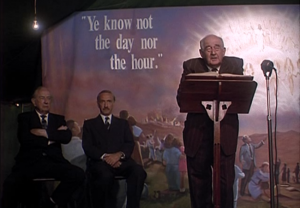
Seventh-Day Adventists have a disproportionate amount of attractive women. They tend to be shy and modest and that makes them all the more appealing.
I totally dig modest women. I respect the chaste. I admire feminine reserve. I just love to get with prim and proper girls.
From the movie: “Being a Seventh-Day Adventist was hard but it was kinda fair. They quickly sorted out the ones they couldn’t trust and branded us with the mark of Cain and sent us wandering, fugitive sinners, through the Land of Nod for all our days.”
The Nostradamus Kid is an Aussie coming-of-age film about a kid raised as a Seventh Day Adventist who struggles to adapt to a secular world when he enters the university in Sydney, and must find his place among atheists and Presbyterians. Given his intellectual curiosity and his natural state of randiness, he is more than willing to move into a more mainstream belief system, but like the rest of us he is never able to shake his childhood faith completely. The entire “end of the world” concept is so deeply embedded in his subconscious that the Cuban Missile Crisis sends him into a tizzy, whereupon he drags his girlfriend into the interior, in search of a fallout-free zone.
Writer/director Bob Ellis is a syndicated columnist, a regular raconteur on Aussie TV chat shows, and the author of more than a dozen books. He has acknowledged that this film is essentially an autobiography, and has offered the very specific estimate that 93% of it consists of his own life experiences. (What, no decimal points? Such imprecision.) “I had several adventures with the possibility of the end of the world. The first was during the Suez Crisis of 1956, when I thought the Bible proved that…et cetera. The second was the time of the Cuban Missile Crisis, where I took the daughter of David McNicoll to the mountains in her own father’s stolen car, and found to my amazement the world hadn’t ended. There wasn’t a mushroom cloud over Sydney, and I had to bring her back and face down David. And I had this plan that we would marry in Broken Hill and slowly cough ourselves to death with the radiation, after long hours of making love.”
I’m going to rewatch this movie and free associate on my blog.
* The movie opens with the singing of this hymn. Compared to the hard work of a Jewish service, the Christian worship seems like crack cocaine of emotion. Christian services stress emotion much more than do Jewish ones. Christian sermons stress emotion much more than Jewish ones. Christian services stress God, faith, love and the next world much more than Jewish ones which are much more pragmatically oriented to our daily behavior. I had many more spiritual highs at Christian services than I have had at Jewish ones. It just feels so good to be in church and to get swept away on the romantic story of God sending his son to die on a cross. It’s rare to have these experiences in shul, particularly Orthodox shuls.
* After the protagonist Ken Elkin loses his virginity, he becomes much more cagey about where he puts his heart. I identify with that. Sleeping with a lot of women hardens you. You’re not as vulnerable to oneitis.
* The protagonist is not particularly choosey about where he beds his ladies. The Torah commands us to not study Torah in the bathroom. We would do well to extend this commandment to the act of love.
* In its irreverence, this movie is very Australian. “It was like getting baptized. You’re totally immersed and you come up spitting water expecting the holy spirit to land on your head and choirs of angels. And then there’s this dead still silence. Everything is as it was except that you are soaking wet.”
* This woman about to take his virginity is surprised the young man hasn’t had a drink all night. “It’s against my religion,” says the lad. “It’s against the religion I used to have.” I’m the same way. I don’t drink alcohol. Force of habit from the religion I used to have.
* Seventh-Day Adventists are sneered at in Australia for being so unAustralian — no drinking, vegetarian, pacifists, against competition. Australians love competition because the only way they survived in this brutal continent was to compete with nature.
* 15:50 in. The bloke explains to the girl, “I’m very impatient. The end of the world is nigh. There are signs and portents.” I’ve never used that line.
* 17:05. The girl says, “I think you’re a very interesting person.” Oy, how many birds have said to me!
* The threat of Adventist violence. Adventists tend to overwhelmingly be pacifists. It is rare that Adventists burst into violence. But off-shoots of Adventism such as the Branch Davidians can explode. Underneath the gentle exterior of Adventism beats a wild heart and Adventists can react unpredictably. They’re not just a bunch of benign healers. In Rwanda, for example, Adventists seem to have been as likely to participate in genocide as any other group. In Nazi Germany, Seventh-Day Adventists lined up solidly behind the Nazis and even turned over their own Jewish members to be sent to the death camps. On the other hand, a Jewish holocaust survivor told me that he was sheltered during that terrible time by Adventist farmers.
* The only other good movie I can think of about Seventh-Day Adventists is A Cry in the Dark. I have not seen The Road to Wellville but it got lousy reviews.
* 32:00 The girl asks for the protagonist to write her another letter. Girls love attention. They love these little boosts to the ego.
36:00 Sister White teaches that you should not tell a joke unless it is for a moral purpose.
* One Aussie rocker said that Australian girls are as rough as bags. Not entirely fair, but they do tend to not wear make-up unless it is a special occasion. I found that American girls take more care with their appearance. Aussie girls are more rough and ready. American girls are much forward than Aussie girls. There’s more chivalry in American dating. American men are more sensitive than Australian ones. They’re more likely to open doors and to go to efforts with the ladies.
* 37:00 Girl says, “You don’t think we’re putting off all the good things in life until we die just because this stupid old bitch [Ellen White] got hit on the head and started having visions.”
“Have you tried the Catholics? They make sense when you’re there. They all make sense when you’re there. They might all be wrong.”
* 37:40. Ken says, “Bugger it!” His mom pops in and says, “You mind your mouth young man or I will wash it out with soap.”
The use of profanity got enormous attention in my Adventist upbringing. It’s a minor matter in Judaism. I’ve never heard a Jewish sermon against swearing. I don’t recall it being mentioned from the pulpit.
47:00 Ken tells Jennie O’Brien, “We’ve got the clap.”
She says, “Who were you with? An Asian?”
* Ken is just gross. He reminds me of myself. He’s self-centered, rude, and a pig. He occasionally gets women who are far better than he deserves. And he keeps asking them to marry him. I’ve yet to ask a girl to marry me. I’m 45. I ought to hurry up. I should just do it for the charge and then write about it. The author of this screenplay, Bob Ellis, says he asked eight girls at university to marry him and they all turned him down.
* 51:00 After getting rejected by Jennie, Ken goes to a strip club and has his first beer (with a grilled cheese sandwich).
* 4:15 p.m. I decide on an early dinner — two chewy chocolate granola bars with spoonfuls of peanut butter, chocolate soy milk, and an apple.
* 55:00 Ken says W.H. Auden was pretty wise for a poofter. He talks to a black man who says, “I was brought up a cannibal. Now I work for the ABC.”
* 1:03 Ken writes in his university newspaper that Jesus was a homosexual who was rooting John the Beloved. “Why else was he the beloved?”
* 1:05 The Adventist at the bar doesn’t want a lemon squash, my favorite non-alcoholic drink in Australian bars, because “they might put something in it.” Why are lemon squashes so difficult to find in the States? They’re a bloody good drink.
* 1:15 Sister White said not to hold hands before you’re engaged and not to kiss before you’re married. Wise counsel!
* 1:18. Last night on earth according to the Book of Ezekiel. How to spend it? Ken’s friend suggests, “Let’s rape all the women.” They then narrow their designs to the pastor’s daughters Esther and Sarai Anderson. They get chloroform. They move towards their tent. Then they see Pastor Anderson with his kids and decide against rape. I find this moral struggle very moving. Truly the heart of man is beastly!
* 1:24 There’s a lot more pessimism in the Australian and English ethos than in America. Why? I think the major reason is that America is religious and England and Australia are no longer. I suspect that when England was more religious, such as in the 19th Century, it was more positive. But even then it wasn’t as positive as America. Perhaps it is the American dream of the frontier? That you can always go west and reinvent yourself? Another reason for American optimism versus European pessimism is that America is more individualistic and free-market and this makes people happier than being taken care of by the state. Perhaps optimism goes with being number one. I don’t think Jews tend to be as optimistic about life as Christians. It’s easier to be optimistic when there are two billion of you as opposed to 14 million.
* Pastor Dibley says he’s sought all his life for an adequate definition of love. That’s something Christians are into. Love, love, love. The pastor says that love is “fullness of response.”
* 1:27. When Ken asks Jennie to come over, she says, “You left a pair of socks behind.” Women are great about practical stuff like that. You only want to root but they often have to have a pretext to come over. Perhaps they’ve bought a sack of potatoes on sale and want to give them to you. That happened to me once and I got a glorious shag from my ex-girlfriend of five years past. Afterward, she said that the ten girls I’d been with since her had taught me well. “You used to be so awkward.”
* 1:47. He goes back to a Seventh-Day Adventist church. “It was strange being welcomed there. These were my own people. I felt at home and not at home at the same time. I wasn’t one of them anymore but I should’ve been.”
Under this great Adventist artwork, Ken finally shags Esther. “No,” she says. “It hurts.”
* Australian movies are not nearly as romantic as American studio ones. They’re much more realistic.
* 1:50. “The Presbyterians were better behaved than the Adventists when they came down to the big city. The Adventists had this problem with fullness of response. I don’t think I ever got over it.”
Cannibal in the bar: “We were both brought up in primitive religions. That can be a comfort sometimes.”
* 1:53. Two weeks after his 40th birthday (in 1982), Ken runs into his old Adventist mates Wayland and Sarai Anderson at the Sydney Opera House. They’re drinking wine.
Wayland: “You know how Mrs. White is supposed to be inspired by God? Well, it turned out that half of what she wrote was copied off of other writers. That much couldn’t have been inspired, could it? And she said it was. Lying old bitch. It’s sad. The whole church is falling apart.”
Ken: “Everyone else believes in the end of the world now. Atomic war. Nostradamus… We won, didn’t we? We convinced them all that the end of the world is nigh.”
I think I can explain the protagonist’s debauched behavior. He had debauched kinesthesia. He had bad use of himself. He was a slave to his unconscious habits of needless tension. If only he’d had some Alexander lessons, we would’ve had a happier movie.
The movie was based in part on Ellis’s relationship with Penny McNichol, now Penelope Nelson. She told me via email: “I drove. It was my mother’s car. Ian Masters was with us. Bob was thin in those days. What more can I say?”
Jan McGuinness writes in 2016:
Ellis says that back in 1966 they agreed adultery was inevitable and should be entrenched. ‘After three days the house rule was to ring in if staying out overnight.’ Though this pre-childbearing ideal is long past he concurs that affairs shouldn’t be an issue among mature adults.
‘But this was and she wasn’t too good for the first three hours, after the baby story broke in the newspapers, which was not intended, and I thought we might break up. By the fourth we were giggling and planning spin doctor lines.’ Indeed, Anne wrote all the press releases and statements and did most of the talking to the press because ‘Bob tends to be too honest with journalists on the hop’.
This includes threatening them and telling them to fuck off as duly reported when the baby story was running hot. Unsurprisingly, he detects some resentment in their treatment of him:
It’s resentment for someone who’s tried a number of things and not done too badly at some of them whereas they’re locked up in their zoo writing 300 words for Murdoch. Plus I have permission to write with passion and some honesty so they try to get something on me. It’s really a kind of road rage and always from people I haven’t met. The one thing that would really hurt is if they got me on hypocrisy, but they can’t find it.
So how does his support for free speech sit with efforts to suppress reference to his affair with Penny McNichol, daughter of the Bulletin’s David McNichol, in her book Penny Dreadful?
My objection was not so much about what was in the book but what was left out. We had engagement and marriage plans, which explains my harassment of her after we split up. I had no particular agenda, the publisher wanted me to sign something saying I wouldn’t sue so I read the book and discovered this thin, ugly, unpleasant character full of violent villainy who bore no resemblance to me.
It would be as if Ted Hughes wrote memoirs ignoring his marriage to Sylvia Plath. She left out our plans because it would have made it a more normal story and turned the break-up of a teenage couple into what amounted to Taxi Driver. There were about 70 things I wanted changed, they changed 28 and published anyway and I didn’t sue.
At the time, it was another of those confidence blows Ellis is prone to:
The fact she discarded me became the driving force of my life for the next couple of years. It’s a big thing to make plans to marry someone. I had an interview with David McNichol, who said I was becoming a bit loopy and should break it off. The idea of being marginalised by the power elite of Sydney I wanted to be part of was devastating.
Ellis settled instead for being on the fringe of another and quite different power elite—the Labor Party. Writing for National Review in 1971 turned him onto the seduction of politics and there’s barely a big moment he’s missed since.
It’s the drama of seeing people in penultimate moments of their anguish and the randomness of decisions. I was there the day Whitlam was sacked and the night he resigned, in the tally room when Hawke won, at Blacktown when Keating won and lost. Those are irreplaceable experiences. Like others follow Test teams to the West Indies, I follow politicians.
And yes, he says with a big sigh, hands clasped as always across his tummy, he’s much happier when Labor is in. ‘Look what happened in ’83. Within months we had The Gillies Report and A Night with the Right. There’s oxygen in the air and freedom under Labor which people don’t dare to aspire to under conservative governments.’
There is an audience for his musings on this and countless other topics. Even if he doesn’t get a very good press, Bob Ellis is well read. His latest book was reprinted before publication and has sold more than 7000 copies, meaning there must be a good number of fading females with cats and young male students with all their disillusion ahead of them, which is how he describes his following.
Perhaps by reading him they’ve discovered that Ellis improves on acquaintance. The last word on this score goes to Noah Taylor, who didn’t want to play him or have anything to do with an Ellis project until persuaded to read the script of The Nostradamas Kid.
People love to focus on Ellis the clown, but not much is ever said about the Ellis who fights for what he believes in, Ellis the moralist, Ellis the humanitarian. I’ve seen Ellis be the fool, but I’ve also known Bob to be one of the kindest and most generous people I’ve ever met. If Bob had moved to London in the sixties à la Clive James, Barry Humphries et al., I have no doubt he would be a very rich and famous man. But he stayed because he loves Australia and Australians and has fought for them and written for them and made a lot of people laugh for a long time. Viva Ellis!
Bill Shorten’s epitaph delivered 16 years later at a memorial ceremony for Ellis was based on decades of Ellis friendship, criticism and correspondence. ‘If I had a dollar for every killer line Bob has sent me over the years in unions and politics, I’d almost be able to afford the legal costs to use them,’ he told the crowd of 400 including Germaine Greer, former Labor premiers Barrie Unsworth, Nathan Rees and Mike Rann, Graham Freudenberg, former union boss Paul Howes, Rhys Muldoon, John Doyle and Marieke Hardy.
‘He belonged to a generation of Australian genius whose irreverent disregard for convention helped sculpture an independent and confident sense of identity free from the cultural cringe. He helped write and tell our national story.’
