Tuesday, December 27, 2005
Email Luke Essays Profiles ArchivesSearch LF.net Luke Ford Profile Dennis Prager Advertise On LF.net Dec 16 Jim Sleeper: "Behind the Deluge of Porn, A Conservative Sea Change." Rabbi Meir Kahane Boy Vey!: The Shiksa's Guide to Dating Jewish Men by Kristina Grish. Tabloid Baby's Person Of The Year: Runners Up
Atheism Is Dull
"Among the repulsions of atheism for me has been its drastic uninterestingness as an intellectual proposition." (Self-Consciousness by John Updike, pg. 141)
British man on his hands and knees for love
LONDON (AFP) - A British man is giving a whole new meaning to begging to be loved as he set off on a 55-mile (88.5 kilometres) crawl on his hands and knees to find a partner.
With a sign saying "Could you Love Me?" strapped to his back and 18 boxes of chocolates trailing behind him on string tied to his wrists and ankles, Mark McGowan began his unusual quest to find a girlfriend.
His route will take him from the site of the Tabard Inn, in Southwark, south London, to Canterbury Cathedral, following the pilgrims' trail made famous in 14th century author Geoffrey Chaucer's "Canterbury Tales".
The 37-year-old performance artist, who said he is also hoping to raise awareness of people left lonely and isolated during the festive period, is hoping to complete the back-breaking task within 30 days.
My Friend Kendra Jade In The Headlines
Star magazine is printing a story that she had an affair with Kevin Federline (Britney Spears' hubby) on Britney's birthday.
I IM'd Kendra Jade this afternoon and all I got was this automatic message: "People in Ethiopia are starving and dying. Hope you enjoyed your Christmas presents."
Then she gave me a "no comment."
My Last Shiksa
I was emailing my mom about my new novel based on the Robert Browning poem. "I don't like to be on my own, so it is always nice to have an attractive younger woman looking after me...and they all make more money than me and pay for our dates... I did not buy one present this holidays nor send one card."
My mom replies: "You should write a book called The Last Scrooge, based on Christmas Carol by Dickens."
Very funny.
"Things are bad, the three ghosts will turn up shortly."
Talking To Teenagers About Sex
Kugel Schreiber writes Cathy Seipp:
God or nature or whatever you may choose to call the Prime Mover made teenagers both fertile and randy. So it makes sense that they would be having sex with one another, right? The proper way to deal with these powerful impulses is to acknowledge their existence and take the logical next step, which means some combination of rigid segregation by gender and early marriage. That's what other cultures do, and with a great deal of success. The obvious way to prevent teens from having sex out of wedlock is to encourage them to marry at 17 - 19 or so and thus have sex within the confines of matrimony, or to physically deny them the possibility of having sex altogether. Otherwise, nature will not be denied.
Should women like Amy Alkon, who have opted out of the gene pool from which all future generations of human beings will be formed, be taking part in any discussion regarding human reproduction and sexuality?
'True Love Is The Best'
Help me!!! I’m back from Vegas and DK has come to the rescue by finishing my homemade truffle gifts. I’ve had too many glasses of Veuve and have been on and off sick for like a week. I also had too much Holiday shopping to finish today for DK. It sucks when you actually find "the one" and really care about each and every gift you get him. F--- me!! I hate consumerism and love things at the same time. I wish I could just tie a ribbon around myself for DK’s holiday gift, but I still feel the need to get the perfect presents. They bring happiness to one’s face --for like 5 seconds of time—and I long to see that "oh my god!!!" look on DK’s face. DK won’t act that way if he doesn’t love something. Just like he can’t lie to me—true love is the best.
I Am A Wild Bull
Normally, my personality is as gentle as a lamb. Put me in a party and I freeze up. I feel my insecurities and I'm unable to approach people.
Somehow, this holiday season, I've been full of testosterone. I've had the stamina of a 17-year old boy. I'm knocking people down. I'm offending. I'm telling loud boisterous stories.
Go ahead, drive those nails through my hands. The day will come when you will see that I'll rise again.
David Hafetz writes in the New York Post:
December 25, 2005 -- A prominent rabbi is being accused of unorthodox and disturbing behavior — seducing a troubled woman in his congregation by telling her he was "the Messiah" and giving her "sex therapy" to help her find a husband.
According to a lawsuit filed last week in Manhattan, Rabbi Mordecai Tendler of Rockland County promised the woman, who was seeking advice, that "doors would open" and "men will come" if she had sex with him.
The rabbi, a father of eight, allegedly told the woman that he was her "only hope." The woman says the rabbi held liaisons in his rabbinical study from 2001 to 2005 and threatened her to remain silent about "the sexual therapy."
Adina Marmelstein, 43, who lives in Manhattan, accuses Tendler of deceiving and violating her and going "beyond all bounds of civility and decency" while he acted as a trusted counselor and spiritual authority.
"He had a tremendous amount of power over her," said Marmelstein's lawyer, Lenore Kramer.
Marmelstein says she first met Tendler — the son of a Yeshiva University professor and the grandson of a highly respected religious arbiter, the late Rabbi Moshe Feinstein — through his "work on behalf of women" in 1994.
In his career, Tendler has advocated for the rights of Orthodox women and assisted Jewish wives obtain religious divorces.
...According to her suit, Tendler warned that he would "have her placed in a straitjacket" and "banned from the shul" if she told anyone about the sex.
Kramer said it was difficult for her client to accuse the rabbi. "It's an embarrassment to the family, a terrible thing."
Remembering YULA History Teacher Fred Shuldiner
His students say he was their best teacher at the Yeshiva University of Los Angeles boys highschool. He was also gay and died of AIDS in 1994. Many of his former students stayed away from his funeral, believing that was the will of their Rosh Yeshiva (head of the Yeshiva) Shalom Tendler. Though it was not explicitly stated, the students were told it was wrong to honor a gay man who died of AIDS.
There were also students and rabbis who visited Shuldiner in his dying days and some of his students attended his funeral.
Picky Eaters Are Confirmed Bachelors
Is it possible that there’s a correlation between being a picky eater and being a confirmed bachelor? It has recently occurred to me that all the truly picky eaters that I know (I’m referring to men only here), are either long-term bachelors, or guys who resisted marriage for as long as they possibly could.
And if there’s a correlation, would it also be true that there’s a causal effect? That the carefulness and sensitivity associated with picky eating extends to their relationships with women?
Anon replies: "Ooh, can we name names here and gossip about Luke? We all know he eats about 5 foods... I don't think it's that that means these guys are "picky" about women, but that they probably have control issues and many rules about women and relationships, just as they do about food, which quickly or eventually bump up against real life and/or real women. I like men with a good appetite."
Elia Eherenberg writes: "I think this idea is bunk. If Luke had not contracted CFS, if he had finished his education as he was meant to and earned his Phd at the London School of Economics, he would have long since married and we would know him for other things. (And being a convert Jew or a picky eater would not be included among them.) He is single because he is poor, without a means of supporting a wife and family, and not because of whatever makes him a picky eater."
Luke: If I had money, I'd have honey.
ChaimAmalek: No, not quite my point. If you had not taken ill, you'd have gone to England, finished your studies, married a grad student or journalist, had kids, a job, etc.
ChaimAmalek: And today we'd not know one another. Likely you would have an almost entirely different set of friends, overlapping but a bit with the ones you now have. And you would not be Jewish.
ChaimAmalek: It's as Phil Ochs sung it "There but for fortune, go you and I...Show me the city, with buildings so tall.: Show me the reason, why the bombs had to fall. And I'll show you a young man, with so many reasons why. There but for fortune, go you or I you or I.
Phil Oaks. Alcoholic folkie who killed himself in the seventies.
You know we can't make good luck for ourselves, but we can make bad luck for others. That's why I'm now a bolshevik. I want a revolution against all the successful people in the world. I want what is theirs, money, women, all of it.
You could have sex any time you wanted it, and from multiple sources, and for free. That's the difference between Luke Ford and Hymen Hebstein. Women don't like messing with a fat old poor Jew but they will service you. You are just too picky, dreaming as you do of the man you might have been and the sorts of women that man likely would have held out for.
On Christmas Day, Do I Reminisce About My Christian Childhood?
People ask me this all the time. The answer is no. Three hundred sixty five days a year, I primarily think about sex with hot chicks. I know I should be more elevated, but I'm not. God grant me chastity, but not yet.
I Want You To Understand And Appreciate Me
I meant to say this on the phone but didn't when you asked about my day...
My situation in shul and in LA Orthodox Judaism is as alienated as I am elsewhere... Most people ignore me or shun me, while a few people are very loyal friends and enjoy my writing and sense of humor and sarcasm. In Orthodox Judaism I often have to run into people who were active in getting me banned from their shul or people who have just formed the opinion that I am pure evil. In other words, it's just like being around the subjects of my secular writing. It's the same with the LA Press Club etc. A minority of people I know love what I do/write/say while most people do not care for it. I believe you understand me. I have a huge need for some people to understand me and appreciate me. And I like to hear that. Without four people, my shul would be a cold place and my life would be a cold life.
Disrupting Dinner Parties
Cathy Seipp and I went to a dinner party Friday night (I walked home from shul, met Cathy, and walked a few blocks to the party). It was filled with old wrinkly liberals.
"I understand people get old," complained a radiant Cathy, "but why do they have to have so many wrinkles? My dad doesn't have wrinkles."
I'm not sure what tires Cathy more -- chemotherapy for her lung cancer or her 16-year old daughter Maia's refusal to follow her advice on how to write an essay. (Maia made minor revisions all Friday and then brought her slightly-improved essay back to Cathy for further critiques. Cathy berated her. Maia chose to stay home from the party and robbed herself of drinking in my wisdom.)
I responded to Cathy's trying time with a telling analogy. "I've had girlfriends who'd get on top of me and ride me like crazy. They'd be screaming and moaning and freaking out. I'd just lie back. Eventually, when their moans would crescendo, I'd start laughing."
The moral is that we tend to take advantage of people's generosity. I, in particular, am a lazy person and a lazy lover. I like my readers and lovers to do the work for me while I lie back and harvest the rewards of their labors.
Pierced by the stunning clarity of morality tale, Cathy appeared ready to burst out sobbing on my shoulder, only the light change prevented this public display of affection.
Cathy has a friend in Silverlake who lives near a bar. Once he caught someone peeing into his backyard. "If I had toilet paper, I'd take a dump too," said the urinator.
Back to the party. One Italian journalist told me with pride that she doesn't write about the private lives of celebrities. If they have drug problems and the such, she doesn't write about it.
"If I did, I would be so much richer and more famous and more successful," she intoned.
I've heard this fatuous remark from numerous journalists who are proud that they avoid gossip.
I agree that relaying gossip is often it not usually a bad thing. I agree that prying into people's private lives is usually repugnant. I disagree, however, that journalists who don't write about the private lives of celebrities are necessarily doing something virtuous (or that they are sacrificing their careers for some higher good, on the contrary, the more aggressive reporters, such as Mark Ebner, get blackballed for telling the truth, and now Ebner has to write for the National Enquirer).
In my view, it is sometimes right to write about a person's private life and sometimes it is wrong. What determines the ethics of matter are the results.
I asked the lady a few questions.
"Are you interested in people?" I asked.
Yes, she was very interested in people.
"Are you only interested in their good side?"
No.
"Do you like to paint a human picture of your subjects?"
Yes, but not about their private lives.
She took offense at my questions and I moved on to a nice old lady (who I found out after the party was Marcia Nasatir (the first woman V.P. of a major studio, United Artists, in 1974) who I'd wanted to interview for my book on producers).
Marcia gave a sophisticated critique of the historicity of Steven Spielberg's movie Munich.
I immediately warmed up to her. This was a sharp lady.
She loved Brokeback Mountain.
I sought to take our intimacy to the next level and asked her: "If one does not want to see Brokeback Mountain because one is not interested in seeing homosexual love stories, does that make one homophobic?"
Marcia said an emphatic yes and that was the end of my conversations with her.
Next I whined to the music editor of The Hollywood Reporter about heartless shiksas who trample on your heart and make repeated claims that Nora Jones and the Rolling Stones are objectively superior music to Air Supply and Barry Manilow.
He clinked his glass to mine in sympathetic agreement and walked off.
I found a ravishing young shiksa (film reporter for the trades) and lectured her at length why she should convert to Orthodox Judaism so she could make Jewish children with her charming husband. Then we immediately segued into deploring the paucity of sex in mainstream American cinema.
Poor Cathy got stuck with a liberal in the corner berating her about George Bush.
Poor Hostess had a stream of people coming up to her and asking, Who is that guy? He said X to me about Brokeback Mountain. He said Y to me about Munich. He said S to me about Air Supply.
"He's just a provacateur," the hostess replied.
In retrospect, I'm glad about the number of old people at the party because it helped me push my chastity mode to 16 days.
At 9:30pm, Cathy demanded that we go home and make the Sabbath day holy as the Torah commands.
Saturday night. I'm introduced to a woman with large luscious breasts falling out of her top.
"I think I know of you," she said. "What's your last name?"
I tell her.
"I know your ex-girlfriend... We worked together. I heard all about you. Some of it was quite unsavory."
How Should I React To People Who Congratulate Me For Coming Out With My Asperger's Syndrome?
Asperger's is marked by "autistic-like behaviors and marked deficiencies in social and communication skills."
My friend who wrote the now defunct-lukefordseeksawife.blogspot.com made a post on their (about a year ago) in my name saying I was coming with my Asperger's. Since then, I've had a host of well-meaning people (including a licensed therapist and some I've spent hours with on the phone) congratulate me.
How am I supposed to react to that? Could someone who has read a few of my interviews honestly think I could've achieved them while suffering from Asperger's?
Here's the latest email I received:
I do recall reading (or hearing) that you had recently identified yourself as having Asperger's. Good for you. You put a face on that condition and can't help but raise some awareness along the way. My teenage son has autism and I have met lots of Aspies over the years --- even before the tern "Aspies" was coined.
I replied: "My aspergers remark was only a joke. I don't have it. sheesh, so many congratulated me on coming out... I'm just plain rude."
He replied:
Luke, I wasn't kidding about my son's autism.
But in the grand scheme of things, this joke is actually on you.
However, I still sincerely send all of the appropriate holiday greetings and suggest you get out the nearest abacus, adding machine or calculator and count your proverbial blessings.
I replied:
We have several families in my religious community with children with autism. The commitment and unselfishness the parents display is awe-inspiring... As someone who has never had a kid, I can't truly understand what it means for someone with your paternal challenges, joys and sorrows...
Chaim Amalek's Christmas Message
He writes:
Luke, the correct way to respond to someone congratulating you for coming out on having Asperger's (and why is it that I'm never the one congratulated for this sort of thing?) is to take advantage of the situation. If the well intentioned person is a man, tell him you are poor and follow him around a bit asking him for a job. In the circles in which you conduct so much of your social intercourse are many powerful Hollywood and Media type Juden who, much as they are willing to patronize Negroes with affirmative action, might well be willing to patronize Luke Ford if they think he suffers from this neurological ailment. Think like a Jew and take advantage of them. On the other hand, if the person happens to be a fertile woman with good genes, you should immediately ask them to have some kids with you. If they are really sypathetic souls, they will either understand you and pat you on the head, or better yet, help rebuild the Jewish Nation using your seed. And if they turn you down, likely they have Asperger's too.
By the way, undiagnosed Asperger's syndrome can be a powerful analytical tool for explaining much of history. For example, do you know why the Jews of the Sanhedrin failed to perceive Jesus' divinity? Asperger's.
A Special Christmas Treat
Skeptical journalist Emmanuelle Richard writes Chaim Amalek: "Dear Chaim: I am a French journalist who, like all progressive French, tailors her writing so that it need never be concerned with the rise of Islam in the lands once made safe for Christianity by Charles Martel. Many of my friends who ignore your warnings on this topic also insist that there is no Chaim ("the hammer") Amalek. My editor says "If you see it on the Internet it's so." Please tell me the truth. Is there a Chaim Amalek?"
Chaim Amalek responds (and he only responds to her, and not the dozens of other emailers who question his existence because she is young - although not as young as she once was - French and beautiful though married):
Emmanuel, your friends are wrong. They have been affected by the skepticism of a skeptical age. They do not believe except what they see. They think that nothing can be which is not comprehensible by their little minds. All minds, Emmanuel, whether they be men's or women's, are little. In this great universe of ours man is a mere insect, an ant, in his intellect, as compared with the boundless world about him, as measured by the intelligence of grasping the whole of truth and knowledge.
Yes, Emmanuel, there is a Chaim Amalek. He exists as certainly as love and generosity and devotion exist, and you know that they abound and give to your life its highest beauty and joy. Alas! how dreary would be the world if there were Chaim Amalek! It would be as dreary as if there were no Emmanuels. There would be no womanly faith then, no poetry, no romance to make tolerable this existence. We should have no enjoyment, except in sense and sight. The eternal light with which the internet fills the world would be extinguished.
Not believe in Chaim Amalek! You might as well not believe in equality, liberty, or fraternity! The most real things in the world are those that neither journalists nor porn stars can see. Nobody can conceive or imagine all the wonders there are unseen and unseeable in the world.
Only faith, fancy, poetry, love, romance, can push aside that curtain and view and picture the supernal beauty and glory beyond. Is it all real? Ah, Emmanuel, in all this world there is nothing else real and abiding.
No Chaim Amalek! Thank God! he lives, and he dwells in New York on the Upper West Side. And for so long as internet archives are maintained of lukeford.net, so too shall he live on. Chaim Amalek wishes everyone in Luke's community - even those who foolishly deny the existence of Christ Jesus - a very merry Christmas and a happy new year.
Are Jews A Clue To A Mystery?
In her book Two Covenants: Representations of Southern Jewishness, Eliza R. L McGraw writes about [Roman Catholic] Walker Percy's 1966 novel The Last Gentleman:
[Will writes in a letter:] "For some time I had believed that the Jews were a sign, a clue to the mystery, a telltale bent twig, a blazed sapling in an otherwise riotous senseless jungle. But now it appears the Jews have not left North Carolina after all, and in fact are making porno flicks and building condos and villas in Highlands, enjoying the leaves, and in general behaving like everyone else. There goes the last sign." (Percy, 174)
[Will's] interest in Jewish people and their locations becomes a symptom of insanity that he relinquishes under treatment, suggesting that seeing Jewish people as mere porn stars or merchants is "healthy," while Will's former vision of Jewish people as signs represents an aberration.
Bin Laden's Niece
"NEW YORK (Dec. 23) - Osama bin Laden's niece, in an interview with GQ magazine in which she appears scantily clad, says she has nothing in common with the al-Qaida leader and simply wants acceptance by Americans."
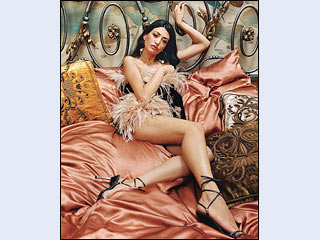
Khunrum writes: "If she slips into my bathtub, we can let bygones be bygones."
Fred writes:
I vaguely recall reading a an article in People magazine about 10 years ago about Stalins granddaughter. She was living in London, I think, and wasn't bad looking, although there was a family resemblance. I remember thinking what my family would think if I introduced her to my family and told them I just proposed to her. Boy, that would go over like the proverbial fart in church.
Chaim Amalek writes:
I have the near ultimate in this genre of story. When I first moved to New York, I happened to meet a woman at a bar with a very interesting story. She grew up in Argentina, the daughter of German immigrants. It turns out this woman had achieved a measure of fame here in the US in the early nineties on two counts. First, she was one of those freako liberal "performance artists" whose art consisted of a public display of her aborted fetus (not making this up - I checked it out on Google). Her other claim to fame was that she was the woman who burned a U.S. flag, leading to a famous U.S. Supreme Court case bearing her name - US v. Eichman - that legalized this sort of activitiy as protected politcial speech.
Oh, about the Argentinian connection - her family moved there after WW 2 because they were on the run. Especially her grand uncle: Adolf Eichman.
PS. And every part of it that I could check out, did check out. At one point in our conversation, I think I had a shot of getting into her panties - I forgot to mention that she was hot looking, tall with long brown hair and huge natural breasts. Then we got into politics and you know where that led. I think I told her something like "the apple does not fall far from the tree."
Khunrum writes: "My only brush with anyone famous was that I once boffed a 40ish woman who was the one time lover of Oleg Cassini the fashion designer."
Tony Peyser's Luke Ford Holiday Poem
I must be a good person because I get invited to cool parties...I had to park half a mile away and hike uphill past Adam Parfrey's place because my van has trouble starting unless it is parked on the flat (even then it can be a heart-stopping experience, good thing I haven't had a date in a while). --- Luke Ford
Luke needs to find
A way if he can
To somehow fix or
Replace that van.
With it, he won't meet
Girls who are cool
Right now he's just
Kicking it old shul.
El Al Flight Lands In Tel-Aviv In Mid-December
As the plane settled down at Ben Gurion airport, the voice of the captain came on: "Please remain seated with your seat belts fastened until this plane is at a complete standstill and the seat belt signs have been turned off. We also wish to remind you that using cell phones on board this aircraft is strictly prohibited."
"To those who are seated, we wish you a Merry Christmas, and hope that you enjoy your stay ... and to those of you standing in the aisles and talking on your cell phones, we wish you a Happy Chanukah, and welcome back home."
Tabloid Baby's Person of The Year for 2005: Anderson Cooper, Brokeback Anchor
There have been, and are, gay network reporters. Even NBC’s wise John Chancellor reportedly had a men’s room arrest in his past (though he popped out of his closet only sporadically in later years, demanding his name be pronounced Chancel-LOR, not CHANCE-eler).
Anderson Cooper is different. Anderson Cooper reads “gay” on the air. Not “flaming,” like most all of the cloned male correspondents on the ET-Access-Extra infotainment shows, not “screaming,” as was when he hosted The Mole (back when newsreader kingship seemed as realistic a dream as his mom marrying her consort Bobby Short), but so undeniably that everyone refers to him as “metrosexual.”
...All She[phard Smith of Fox News] got for his trouble was an outing by the editor of the Washington Blade.
Book Sales/Oct/2005/Total
XXX-Communicated: 1/15/91
The Producers: 19/70/129
Yesterday's News Tomorrow: 2/11/56
That's what Chaim Amalek tells me. He says that I'm needlessly blowing a good thing, repeating a pattern that I've had running for many years now. "What you ought to do is spend less time obsessing over when 'Hillary' last called you and more time thinking like the sort of man who KNOWS he's going to get the blonde. You need to start thinking like a Latin lover, or a Negro. There must be someone of color in LA who is willing to take you aside and teach you how to be a man, instead of a whimpering idiot who mewls like some lovesick girl after her lover has rejected her for someone slimmer. I suggest that you begin HERE with this column of helpful advice by someone writing for the Village Voice."
Murdered Naval Reservist Paul Berkley Fell Under Spell Of Adult Entertainment
PlanetHuff points out to me that Berkley wrote on his website:
I am Paul , a sweetheart of a guy (my mom says) who in the past fell under the spell of the adult entertainment industry. It all begin simply enough . After being married for almost 13 years ( a deeply religious guy, ordained in my church, conducted babtisms, blessed babies, taught sunday school, etc..) I got a divorce. I sold my budding business rather than have it become an asset in our settlement, and the gentleman (well he was HARDLY a gentleman) who bought it celebrated by taking me to a local bikini bar called "Snooky's". I had been overseas, and by comparison this place was benign. Cold beer, some girls in bikinis, how much trouble can you get in anyway?. Ah, the simple thoughts of a computer nerd.
The first night there I was picked up by a stripper, (Linda/AKA Lydia) (i didn't fight too hard).. She educated me and turned me loose in the industry, where I met and tried to rescue most of the listed girlfriends (the others are a blur...sorry if I forgot anyone...(including whoever belongs to the seafoam green g-string I found in my reptile tank) I worked in a number of professions, including "erotic massage" (little training involved, the first day they said "don't touch the bermuda triangle, and look out for cops!"), live porn (paid by the hour to have sex while people watch.. harder than it sounds...try to be convincing while guys munch chips and yell encouragment ), bikini bar shift manager, Dancer/Escort Mgr. and a couple of adult videos and clips... NO, NO HYPERLINKS TO THE SITES THAT SELL THE VIDEO...YA GOTTA FIND IT YOURSELF.
I have "been to the edge and back" and have little desire to pursue anymore wild and precarious situations, but I feel the experiences should not go undocumented, and should any of these women desire to provide rebuttal, I will provide space for them.It is also the same fairness that forces me to admit that I dearly cared for a few of these women, and while the events here may not exemplify healthy relationships, we had some great times too.
A friend writes:
I am 90% positive that Paul Berkley guy was this compulsive-lying freak who used to hang out in all the strip clubs in Ventura County, pestering the girls and acting like he worked there when he really didn't. I used to dance in Snooky's, which is the bar he was talking about, and also in another bar called PJ's that he also frequented, and we all knew him well. At one point he was claiming he could get me a job in a hospital ER. I told him that I wasn't qualified, but he said he would help me fake credentials. I felt that an ER was not the place to fake credentials. I mean, what if it's a life or death situation and you are only pretending like you know what you are doing?
Obviously, I had no business working there, so I never pursued it. I didn't feel like he could actually get me the job, anyway. He knew I wanted to get out of dancing, so he was just dangling it in front of me to try to get me to spend time with him. He was like that. He always had some kind of drama going on with the girls where he was engaged to one or another one "broke his dick" and things like that. It was really sad.
Recently I was hanging out reminiscing about the old days with a friend of mine who used to work in the bars with me (he still works there), and I asked him what ever happened to that "weird Paul guy" but he didn't know. I just tried calling him to see if he had heard anything about this, but he didn't pick up.
PlanetHuff reports here and here.
Paul Berkley wrote about a girlfriend (at the time) named Monique:
This is Monique, current girlfriend of about 3 months. Never a bitch. Too much to say to get in this little box, but never hits, never cheats, and never eats crackers in bed .Likes me in spite of my scandalous history, (or because of it) and makes the best bean soup in the world.
PlanetHuff.com writes me: "You may be able to find out if he ever really did do anything in the industry that might even still be out there. I haven't a clue as to where I'd start, but if he was telling the truth, apparently there were once extant videos of the now-murdered Navy Reservist and IT guy Paul Berkley getting his bow-chick-a-bow-bow on."
At Church With Luke
We picked up Luke at his Hovel (TM), where he was dressed immaculately in his black suit, carrying a beautiful leather King James Bible his parents had given him when he was nine. He looked serene as usual, even though there'd been another plumbing problem in the Hovel that morning.
"The sun is shining, the sewage is backing up," Luke said, as he got in my car, "and I'm with my two favorite people in the world. What could be better?
"Plus," he added, "I've got a bible in my hand and a yarmulke in my pocket."
A Sexual Predator Holds One Of Orthodox Judaism's Largest Pulpits In Los Angeles - Does Anyone Care?
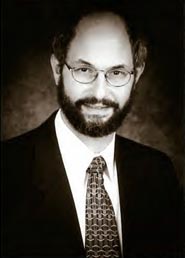
He served as teacher, Assistant Principal, and Principal at the (girls) Yeshiva University of Los Angeles High School.
Rabbi Aron Tendler was replaced as principal of the girls YULA circa 1994 after charges were lodged that he molested teenage girls.
About 40 Orthodox rabbis from around the country will gather in Los Angeles with their Californian peers for the Dec. 22-25 OU West Coast Torah Convention. The theme for the weekend is "The Polarization of Orthodox Judaism."
How about the theme of rabbis who are predators?
There's been a lukewarm investigation of Rabbi Aron Tendler by the RCC (Rabbinical Council of California) for charges that he sexually molesting under-age teenage girls, many of whom were under his rabbinic authority (either at YULA, NCSY or elsewhere). The stories about his behavior have gone on for years. Every major Orthodox rabbi knows about the complaints against Rabbi Aron Tendler, including Rabbi Best, Rabbi Nahum Sauer, Rabbi Fassman, Rabbi Avraham Union, yet Rabbi Aron Tendler maintains his pulpit.
Now women in their 30s (and some younger) who say they were molested by rabbi Tendler in their teens are coming forward.
No civil lawsuit has been filed against Aron Tendler in this matter (due to its nature, the women who say that Rabbi Aron Tendler molested them don't want to go public as most of them have familes of their own, and communities tend to rally around their leaders and stigmatize those who accuse the leaders of sexual misconduct).
Aron is popular with his peers who are loathe to discipline him. Aron is a "nice guy." He's "humble."
From a Tendler perspective, one could view Rabbi Aron's behavior as bagging trophies of the virgins under his care. He did it out of love. He initiated them and prepared them for a mature relationship with their later husbands.
A Tendler could argue that these girls had emotional problems, and he was curing them through bodywork and helping them appreciate the physical dimension of life. This is what God intended in creating the world.
Aron's rabbi-brother Mordecai is also being investigated by the RCA for sexual misconduct.
Rabbi Aron Tendler delivered a lecture at YOLA entitled, "When was the last time you really said I love you?" It's available on 613.org: "The topic itself is one of my favorite topics. I always wonder when was the last time I really said I love you to my own wife."
He also gave a Purim class at YOLA entitled: "In Search of Adam's Clothes."
Chaim writes: "If Mordecai Tendler offered you: a. an important, high paying job in your kehilla; b. sex with ten young virgins; and c. $100,000 - if and only if you stopped writing about him, would you accept the offer?"
No.
"What if he also offered you a special place in the world to come? And a date with the Craigslist woman of your choice?"
Maybe.
Rabbi Aron Tendler reminds me of Humbert Humbert, the protagonist of Vladimir Nabokov's novel Lolita. In one scene, Humbert sees Lolita:
sitting in a study hall with a sepia print of Reynolds' 'The Age of Innocence' above the chalkboard, and several rows of clumsy-looking pupil desks. At one of these, my Lolita was reading … and there was another girl with a very naked, porcelain-white neck and wonderful platinum hair, who sat in front reading too, absolutely lost to the world and interminably winding a soft curl around one finger, and I sat beside Dolly [Lolita] just behind that neck and that hair, and unbuttoned my overcoat and for sixty-five cents plus the permission to participate in the school play, had Dolly put her inky, chalky, red-knuckled hand under the desk. Oh, stupid and reckless of me, no doubt, but after the torture I had been subjected to, I simply had to take advantage of a combination that I knew would never occur again.
Rabbi Aron Tendler is famous for speaking out against domestic abuse (like many predators, he loves to portray himself as the protector of women and children):
Bringing Jewish domestic violence out of the closet
Fine, Arlene. The Cleveland Jewish News. Cleveland: Feb 6, 1998.Vol.68, Iss. 20; pg. 32"The safest place for a woman should be in the arms of her husband," says Rabbi Aaron Tendler of Shaarey Zadek Congregation in North Hollywood, Calif. "If she doesn't feel that way, she must immediately get out of the relationship and seek help. If there is no kindness between a woman and her spouse, the sadness can be overwhelming. No one deserves that."
Rabbi Tendler's comments on domestic abuse and those of several other leading rabbis, plus poignant testimonies from formerly abused Jewish women, are brought into sharp focus in the recently released videotape on domestic violence, "To Save A Life: Ending Domestic Violence in Jewish Families."
The worst advice a rabbi or professional can give a woman in an abusive relationship is to simply return to her husband and forgive and forget, says Rabbi Tendler.
"Certain sins just can't be forgiven. When a woman is being abused, no one should tell her to go home, cook a nice supper and then things will get better. Things do not work that way. Without professional help, there is no way an abusive relationship can suddenly turn into a loving one."
...........
Area rabbis learn about domestic abuse:
Multi-denominational workshop spurs dialogue on a difficult topic.
Rzepka, Susan. The Cleveland Jewish News. Cleveland: Oct 30, 1998.Vol.70, Iss. 6; pg. 18Last week, a group of rabbis from all denominations gathered at Green Road Synagogue to broaden their knowledge and raise their collective awareness of domestic violence. They listened intently to the remarks of Rabbi Aron Tendler, spiritual leader of Congregation Shaarey Zedek in Los Angeles, who has become an expert in the field, and to Marcia Burnam, a survivor of domestic abuse. But many questions remain.
Many Jewish women feel reluctant to come to their rabbis with the problem of domestic abuse, admits Rabbi Tendler. They assume that rabbis, who are usually men, will automatically side with their husbands. They fear rabbis will disapprove of them ending their abusive marriage through separation or divorce.
Women feel the burden of responsibility for shalom bayit, or household harmony, and see the admission of disharmony at home as a public shonda, or shame. The woman's abuser may be an outwardly charming, successful and religious man, and she fears that the community, let alone her rabbi, will not believe or support her.
This, says Rabbi Tendler, is the challenge facing rabbis: To let our congregants and communities know that our doors are open; that we can and will provide "a compassionate and empathetic ear who will listen and say, `I believe you,' when a woman seeks counsel."
"The greater the awareness, the greater the healing," says Rabbi Tendler. The most important thing a rabbi can do for a battered woman, say both speakers, is to listen, confirm, and edge her slowly toward getting the help she needs. Give her the hotline number (216-691-SAFE, for Project Chai, JFSA), a local provider of services for domestic-violence victims, and encourage her to call.
From the Jewish Journal January 30, 1998:
"When I counsel couples, I tell the woman, infront of her intended husband, that if he ever raises a hand to her, she should pick herself up and leave until the problem is resolved," Tendler said. "And if a woman is unsafe, it is incumbent upon every rabbi to pull out all the stops, including saying from the bimah that a man is not welcome in the community, because he abuses his wife."
From the Jewish Journal April 3, 1998:
The close-knit North Hollywood community offers many advantages to Jewish residents
Rabbi Aron Tendler, associate rabbi for Shaarey Zedek, said the primary reason for rebuilding the shul is that thesynagogue can hardly keep up with requests for new classes. Inaddition to his job as an assistant principal at Yeshiva UniversityHigh Schools of Los Angeles, Tendler gives about five community lectures a week.
"There's no question we're benefiting now from the'settled' ba'alei teshuvah movement, those who have [become Orthodox]and are now looking for a community for their kids," he said.
Tendler characterizes Shaarey Zedek's congregation as "eclectic": "Here you'll see black hats, knitted kippot, the newlyobservant and the converted all sitting together. We have a real emphasis on maintaining open lines; we're not into judging people."
From the Jewish Journal March 28, 2003:
Rabbi Mattis Weinberg, who founded Yeshivat Kerem in Santa Clara in the mid-1970s, counts as some of his strongest supporters — and detractors — former Kerem students and faculty members who now live in Los Angeles.
Kerem, which existed for seven years, employed some well-known rabbis in Los Angeles, including Rabbi Shalom Tendler, now rosh yeshiva at YULA; Rabbi Aron Tendler of Shaarei Tzedek Congregation; Rabbi Daniel Lapin, formerly of the Pacific Jewish Center in Venice; and Rabbi Eliezer Eidlitz, now director of development at Emek Hebrew Academy.
From the website of his shul Shaarey Zedek:
Rabbi Aron Tendler has been teaching high school since 1976. His first position was in Phoenix AZ. as Dorm Supervisor for Ohr Hamidbar. From 1977 to 1980 Rabbi Tendler taught in Kerem Yeshiva, Santa Clara, California. He moved to Los Angeles in 1980 and has been a teacher, Assistant Principal, and Principal at Yeshiva University High School of Los Angeles. This past June, Rabbi Tendler retied from YULA to assume the position of Senior Rabbi at Shaarey Zedek Congregation.
This past December, Rabbi Tendler was awarded the coveted Miliken Foundation's Distinguished Educators Award.
In 1985, Rabbi Tendler became the Associate Rabbi at Shaarey Zedek Congregation in North Hollywood, California, the oldest and largest Orthodox congregation In the San Fernando Valley.
In 1996, Rabbi Tendler's position was advanced to Rabbi of Shaarey Zedek, and this past July he became the Senior Rabbi.
For the past nine years, Rabbi Tendler has been the Chairman of the Yeshiva Principals Council.
For the past six years, he has been a member of the Executive Board of the Rabbinical Council of California and currently holds the position of Chairman of the Vaad Hakashrus of the RCC.
Rabbi Tendler is author of the very popular Rabbi's Notebook and Parsha Summary, a weekly essay and review of the Parsha that is posted on the Project Genesis website. More than 11,000 subscribers receive his weekly presentations via e-mail.
Rabbi Tendler was featured in eight segments of Mysteries of the BibIe, a program that is produced by Roos Films and aired on the A&E cable station.
More recently, Rabbi Tendler has received national recognition as a champion and voice combating domestic violence. He is a member of the Jewish Family Services Domestic Violence Task Force. The nationally distributed video, "To Save A Life" produced by the Center for the Prevention of Sexual and Domestic Violence features Rabbi Tendler's passionate and encouraging views.
Rabbi Tendler was married to Esther Shapiro in 1976, and has raised their five children here in Valley Village.
Education
1976 - Smicha - Rabbi Moshe Feinstein
1976 - BS Political Science, Johns Hopkins University
1976 - BA Talmudic Law - Ner Israel Rabbinical College
1986 - MA Guidance and Counseling - Loyola
Demonizing Diseases
[Liberals] demonize or criminalize some diseases. I have seen obituaries which read that the person died of throat cancer. The next sentence reads, that the deceased, "...was known as a heavy cigar smoker for much of his life."
What is that? An accusation of blame? On the other hand, when people are known to die of AIDS, would you ever read that they "are known to have engaged in homosexual acts which might have lead to contracting AIDS?" How dare they bring up smoking as the cause of their cancer in the obituary? What is this, an obituary or an insurance claim? Why does illness have to be politicized?
Set Up An Email List
A man writes:
What an excellent site you have. If you don't already, you really need to have a way for people to subscribe to it, so that as you post new pieces they're emailed out. It's easy and free to set that up (I'm assuming you don't actually have such a thing going in the background somewhere) and presents further directions to go in the future.
I just happened on your site because I was looking for info about my old employer, Arnold Kopelson. You really laid it out well -- the best piece on him I found. Then I got sucked into the pieces about Orthodox sexual predators... excellent from the writing POV, pretty depressing otherwise. And boys webcasting their sexuality for bucks. Sheesh.
The problem is, Mr Ford, the Web banquet is simply too rich to remember good writing sites and keep going back to them. There's definitely something to be said for being more proactive re your readers.
Rabbi Meir Kahane - In Loving Memory
Larry Yudelson writes:
Kahane had a platform at the Jewish Press, in part because he was a serious macher at the paper. What I can vouch for is that during the '80s, when he was in Knesset, he wrote three weekly columns -- one under his byline and two as "David Sinai" mocking the Knesset proceedings and the Israeli news reports.
Kahane's ideological strength was his theological heresy. He argued that history, e.g. the Holocaust, transformed the Jewish covenant with God. In this way he was the theological mirror of Yitz Greenberg at the politically opposite extreme. That Kahane's heresy was kosher at Y.U. and elsewhere, and Greenberg's treif, is to the eternal shame of Norman Lamm's yeshiva.
Where there is no Torah, there is interspecies breeding
THE Soviet dictator Josef Stalin ordered the creation of Planet of the Apes-style warriors by crossing humans with apes, according to recently uncovered secret documents.
Moscow archives show that in the mid-1920s Russia's top animal breeding scientist, Ilya Ivanov, was ordered to turn his skills from horse and animal work to the quest for a super-warrior.
Monday afternoon, you asked me via AIM if I was going to the party that night.
I was so taken aback (after not having heard of the party) that I had to drive to Ralph's to buy ten pounds of orange, four pounds of bananas and 100 feet of mint dental floss before I could answer her.
Still, I felt empty inside. Insecure. Needy.
So off I drove to the drug store and bought a Black & Decker Crush Master to make my smoothies.
Getting and spending, I laid waste my powers.
"Where's the party?" I asked.
"It's invite only," you replied.
I didn't want to crash. I had too much pride to go uninvited.
"I'm not going," I told you.
Then I emailed and asked for permission to come to the party.
At 6pm, Derek emailed me back: "You can come if... comes with you."
I call you. You're going with your ex-boyfriend and coworker. You tell me to print Derek's email. You laugh that I can only get into the party if I go with you.
You call me at 9:38pm as you're pulling away. You beat me to the party by at least 15-minutes.
That's me in the corner. That's me in the spotlight. Losing my religion. Trying to keep up with you. And I don't know if I can do it. Oh no I've said too much. I haven't said enough. I thought that I heard you laughing. I thought that I heard you sing. I think I thought I saw you try. Every whisper of every waking hour I'm choosing my confessions trying to keep an eye on you like a hurt lost and blinded fool. Oh no I've said too much. I set it up.
The slip that brought me to my knees failed. What if all these fantasies come flailing around. Now I've said too much.
12:16pm. He leads you back to the dance floor. I leave.
That was just a dream.
The war in Iraq is a war without heroes
There are no men--or women, for that matter--known to most Americans for their bravery in combat. There are no household names like Audie Murphy or Sgt. York or Arthur MacArthur or even Don Holleder, the West Point football star killed in Vietnam. When President Bush held a White House ceremony to award the Medal of Honor to Smith, posthumously, the TV networks and big newspapers reported the story. The coverage lasted one day. The story didn't have legs.
Jesus skeptics on the run?
Charlotte Allen writes in The LA Times:
Anne Rice's latest novel relies on a biblical scholarship more trusting of the New Testament.
...What is interesting — and portentous — is that just as "Christ the Lord" was nearing release in early September, Robert Funk, founder of the Jesus Seminar, died. The Jesus Seminar is still going strong. But Funk's death and Rice's novel constitute a kind of symbolic marker of the passing of a brand of dogmatic hyper-skepticism toward the Gospels and the rise of a new and more generous biblical scholarship that holds, contra the seminar, that the Gospels and other New Testament writings constitute virtually our only record of what Jesus said and did. These scholars contend that there is no point in trying to deconstruct the Gospels to find the "real" Jesus. They maintain there is nothing in the historical or archeolological record of the 1st century that makes the Gospel accounts of Jesus' life inherently implausible.
There is no change among Bible scholars. Those who are committed to their religion's orthodoxy will filter their scholarship through their beliefs (or they will simply keep quiet about where their beliefs differ from their religion). Those scholars who view the Bible in purely disinterested (that means impartial) terms will not see either the divinity of Jesus or the divinity of the Torah.
If a person wants to believe that Jesus is the Messiah and God, then he can find Bible scholars to support his views (though almost all non-Christian scholars will argue that Jesus never believed himself either divine or Messiah and that the real founder of Christianity was Paul). If a person wants to believe that every word of the Torah is divine and was given by God to Moses at Mount Sinai approximately 3200 years ago, however, he will have a hard time finding people with PhDs from secular universities in the origins of the Pentateuch who will support his belief.
It verges on the impossible to believe in all the essentials of one's religion and to be open to truth from any source. Dennis Prager, the talkshow host who is always talking about how rational he is and how he welcomes truth from any source, admits he would never accept evidence that showed God was not behind the Torah (not that one could ever prove such a thing).
Through His Webcam, a Boy Joins a Sordid Online World
Kurt Eichenwald writes in The New York Times:
So began the secret life of a teenager who was lured into selling images of his body on the Internet over the course of five years. From the seduction that began that day, this soccer-playing honor roll student was drawn into performing in front of the Webcam - undressing, showering, masturbating and even having sex - for an audience of more than 1,500 people who paid him, over the years, hundreds of thousands of dollars.
Justin's dark coming-of-age story is a collateral effect of recent technological advances. Minors, often under the online tutelage of adults, are opening for-pay pornography sites featuring their own images sent onto the Internet by inexpensive Webcams. And they perform from the privacy of home, while parents are nearby, beyond their children's closed bedroom doors.
For almost six years, a little-known Internet company called Neova.net has been quietly processing credit card information for online businesses - among them, Justin Berry and other minors who operate for-pay Webcam sites.
For years, bigfunhouse - which portrayed itself as the most popular site of its kind in America and Europe - offered to members a free link to a second site featuring Webcam videos of boys who were lured into one or two online sexual performances, according to Internet records and customers interviewed by The Times.
E-mail traffic reviewed by The Times showed that, in June, the company that processed credit card charges for bigfunhouse - Verotel, which is based in Amsterdam - received a message purportedly from a teenager whose image was on the site; the message stated that bigfunhouse was carrying child pornography. Verotel - one of the largest credit card processors for Web sites offering digital content, which says it is strongly committed to combating child pornography - replied that it had investigated the claim and had become convinced that it was not true, the e-mail messages showed.
Win A Date With Luke Ford
Chaim Amalek writes:
What are you going to do with all that Levitra you've got lying around? I say you establish a charity and give it to people of color
Too much jew crap on lukeford.net. It's not very manly. In general, the web site is too high in estrogen....posting letters explainng why you broke up with... (an explanation which makes no sense at all, by the way), talk of rabbis, jews, whiny folk. Be more manly, and women will respond with favor to you, and potential benefactors will look to you as the guy with whom they can do important business.
HERE'S AN IDEA: Win a Date with Luke. Put an ad on Craigslist, offer yourself as a date, tell the women you are going to write about it. Hell, have one of your fans videotape the date and launch your own tv career. Part 1: interview the women before she meets you. Part 2: the date. Part 3: commentary by Amy Alkon, Cathy Seipp, etc. Edit it and put it on the web. Make a star of yourself! Be a man. What you need to do is stop questioning me and start doing exactly what I tell you to do when I tell you to do it. Consider me as your oral law. And your life will improve. Trust me. Can I post this on craigslist? In LA, an ad for a date with Luke Ford. "Go on a date with the Famous Luke Ford" "Ride in the famous Luke Van! Visit the hovel in which he lives! Have social intercourse with his circle!"
You are too passive. You must do this for yourself. You need a dominatrix to order your life for you.
I sort of got drafted into this book... Several people pushed me to do it, and have been nudging me along the whole time, and then it just made sense that this was an important and compelling topic.
I get heat too but as I do not know what you are going through, it sounds funny to say anything about me...
Do I care? I think of myself as a reporter and a writer and I generally succeed in keeping my feelings apart from my work. I prefer to be coolly accurate. So if I do feel things I generally try to keep them separate from my work. My work is to tell stories that are important and compelling. So even if I did care, I would not tell people I write about that I do. It is not how I operate.
I know it sounds heartless but I do a form of surgery. It is best to be distant and impartial. If I were in your shoes (and I've never been a victim of sex abuse) I would be more skeptical of people who claim that they care...because people are weird.
What am I is a good listener (not in a therapeutic sense, but in the reporting sense)... I talk to a lot of scarred people, people who've been through hell... They are emotionally volatile sometimes and very needy... I try to be very specific about my mission. It is one of reporting. I am not an advocate or an activist or a therapist or someone who is taking sides.
Jewish Music - Reform, Conservative And Orthodox
Mark Kligman writes an essay on trends in American Jewish music in the new Cambridge Companion to American Judaism, edited by Rabbi Dana Evan Kaplan:
One of the most interesting features of new popular music in the Orthodox community is the sheer volume of it, which represents at least half of all the music available. The Orthodox music industry, based predominantly in Brooklyn, has grown significantly over the past 25 years. This growth is attributed to the limited involvement and participation of right-wing members in secular culture. As a result, they have developed their own type of popular music, whose sources include the Bible, liturgy, and a genre of English songs, which delivers a powerful message of faith and devotion. This new music satisfies the need for religiously appropriate entertainment...
...Currently, the most influential performer and creator of new Reform liturgical music is Debbie Friedman. Finding Reform worship nonparticipatory and thus lacking in excitement, Friedman has committed herself expressions of the liturgical text in order to make the congregant's worship experience accessible. Her first recording was a youth service she wrote for high school students entitled Sing Unto God (1972). ...Influenced by Peter, Paul and Mary, as well as Joan Baez, Judy Collins, and Melissa Manchester, Friedman sought to make prayers and melodies accessible for Reform congregants.
Performer Craig Taubman, who grew up in the Conservative movement, performs in Reform synagogues and other venues. Taubman's songs, which are in Hebrew and English, are responses to events in his life such as the birth of a child and the death of a relative. The style of his songs ranges from rock-and-roll and pop to adult contemporary music; a contemporary style and high production quality in his recordings are evident. He feels that music communicates a powerful and magical message and that some things are better left untranslated, since meaning is conveyed through music...
P. Nagy writes on Amazon.com:
American Jews understand Jewish tradition as cosmopolitan and universalistic. They see Judaism as pragmatic rather than ideological, utilitarian rather than theological, and rational rather than mystical. Many in this group see their practice of Judaism as an all-encompassing pursuit, determining not only religious ritual but also ethical behavior. Another sizable group sees the specifics of Judaism as playing a crucial but more limited role in their lives, believing that their commitment to universal ethical causes derives from their core Judaic values - even if they do not frequently articulate these values in a synagogue or temple. These Jews see liberalism as applied Judaism, identifying Judaism with liberal social causes. However, in recent years, even among this group there has been a pronounced move toward greater ritualism as well. The essays in this collection attempt to analyze various aspects of this American Judaism, a term that - as we shall see - does offer some tentative unity to a religious people with tremendous diversity. There are a variety of perspectives in the American Jewish community that are reflected in attitudes toward specific questions dealing with personal and communal Jewish identity today, such as patrilineal descent, Outreach, the role of the non-Jew in the synagogue, rabbinic officiation at mixed-marriage ceremonies, the ordainment of women, and gay and lesbian participation in the synagogue. All of these issues are being heatedly debated within and across the different denominations (also referred to as movements, streams, or even wings). In addition to these strictly "religious issues," there are also debates on social and political issues that affect American society as a whole. It is not possible to say that American Judaism has a particular position on abortion, capital punishment, euthanasia, or homosexual rights. Many of the denominations have taken official stands on some of these issues, but in most cases there are minorities even within those streams who believe that their religion holds a different view.
The most passionately debated question is whether Judaism can survive in an open American society that has, since the 1950s, become increasingly tolerant toward Jews. Since the 1990 National Jewish Population Survey (NJPS) found that American Jews were intermarrying at a rate of 52 percent, there has been a frantic debate in the American Jewish community: Is Judaism in danger of disappearing in the United States? Some of the optimistic contributors to this volume support the transformation argument: Contemporary American Judaism is not vanishing but is rather transforming itself. These individuals believe that it is essential to look at what is happening in a more sophisticated way and not restrict one's perspective to outdated criteria. Many American Jews are creating new ways of "doing Jewish," blending their own traditions with non-Jewish family rituals favored by spouses or embracing a syncretic creation of American culture and Judaism. Because of all of these changes, one must look in new places to find new approaches.
The pessimists feel that the majority of American Jews have lost all interest in Judaism, and many others have only nominal links. These individuals believe that their future as a people is threatened and only a "return to tradition" can reverse the radical decline. These pessimists argue that low levels of synagogue affiliation, high rates of intermarriage, low levels of Jewish literacy, and weak commitments to ritual observance are undermining Jewish continuity. Another debate centers on the future makeup of the American Jewish community.
Some contributors accept the polarization argument that there will be two completely separate Jewish communities in the near future - the Orthodox and the non-Orthodox. The two groups have less in common and have less contact with one another than ever before. They disagree not only on how Judaism should be practiced but also on the very definition of who is a Jew. Without some consensus on such a basic question, the pessimists believe that American Judaism will split into two separate sects. The optimists hope that some common ground can still be found.
So that we can better understand and contextualize these questions and issues that occupy the American Jewish community, this book is divided into two sections. Part I provides three historical overviews of American Judaism. Eli Faber deals with the period from 1654, when the first Jews arrived in New Amsterdam, up to 1880, when the mass immigration from Eastern Europe was about to begin. Faber reports that some colonial Jews posed for portraits without head coverings, violated the Sabbath laws, and even ate pork, partic¬ularly when they were traveling. A small percentage even married out of the faith. Others were highly observant and followed Jewish law scrupulously. The main difference between then and now was that all five synagogues founded before the Revolution followed Orthodox Sephardic custom. How-ever, American Judaism changed dramatically in the years during and immediately after the Civil War. Faber writes that "the impulse to change Judaism in America surged between 1860 and 1870." Reforms were introduced, in¬cluding mixed seating, the elimination of the head covering for men, and the use of an organ. New prayer books were edited that eliminated certain theological concepts that were now found objectionable.
Lloyd P. Gartner describes the "reshaping" of American Judaism from the late nineteenth century until after World War II. The large-scale Eastern European immigration completely changed American Judaism. Hundreds of small Orthodox synagogues were created in mostly urban neighborhoods. Many people attended Orthodox synagogues because that was what they were comfortable with, but they refused to follow the Halacha strictly, despite the many sermons preached by Orthodox rabbis. Gartner reports that the immigrant congregations reached their peak during the World War I period and then began to decline slowly. New, larger, and more affluent congregations were established. English replaced Yiddish, and American ways replaced European Jewish customs and practices. In the postwar period, large numbers left the urban neighborhoods for the suburbs.
As I describe in my chapter, a Jewish civil religion developed that stressed loyalty to both the United States and to the Jewish people. Levels of anti-Semitism declined, and Jews became fully integrated into American society. They felt a great deal of pressure to express their Jewishness religiously rather than ethnically, and hundreds of suburban synagogues were soon built. The Conservative movement became the largest American Jewish de-nomination, and the Orthodox denomination continued to decline. However, this pattern began to reverse in the 1970s. Orthodoxy began a remarkable revival, spurred on by the missionizing done by the Baal Teshuva movement among other Jews. Lubavitch (also called Chabad) sent emissaries to hun¬dreds of Jewish communities around the country and the world. Among the non-Orthodox, the Reform movement grew, which was due in large measure to the joining of many intermarried couples.
Part II, the bulk of the volume, deals with essential topics in contemporary American Judaism. This Themes and Concepts section is subdivided into Religious Culture and Institutional Practice, Identity and Community, Living in America, and Jewish Art in America. It has essays on religious belief and behavior, structures and institutions, and patterns and stages. Consider-able attention is devoted to the Jewish civil religion, Judaism and democracy, and the essence of American Judaism, as protean as it may be. Other writers focus on gender roles, life-cycle rituals, interfaith dialogue, and religious economics. Particularly innovative are the essays that focus on American Judaism broadly conceived. Mark Kligman explains the role that music plays in American Judaism and Matthew Baigell describes the visual arts. Murray Baumgarten talks about "American Midrash," by which he means the new American Jewish literature that focuses on Judaic story lines. The final essay by Bruce Phillips is a separate subsection entitled "Present and Future Tense: American Judaism in the Twenty-First Century." The volume then concludes with an afterword written by Jonathan Sarna.
I agree with Dr. Jonathan Sarna that this book is a summary of what we know. I didn't learn much by reading it.
I Resolve That 2006 Will Be My Year Of The Mexican
Chaim Amalek writes:
Start acting like a Mac and start smooth talking these women. Your ethics are standing in the way of your happiness.
Resolve today that "I, Luke Ford, can live at least as well as a Mexican." When you meet people on the street or in shul, begin by saying "Hello, I'm Luke Ford, and in the coming year, I'm going to live at least as well as the average Mexican." Baby steps. Then perhaps in a few years, you could extend this proclamation to be based on more successful economic groups. You know -- 2006 could be Year of the Mexican; 2007 the Year of the Philipino; . . . 2025 the Year of the Arab.
The Blame-Free Relationship
...As for being pissed at you for silly reasons... That's not it... My primary feeling these past five days is one of sadness. I don't think you've done any wrong to me. You weren't wrong in not getting back to me on Sunday, or any other time you've tarried in replying to me.
I felt sad and decided to move away because I did not want to play the woman anymore chasing you for more communication. I had gotten to the point where I did not think spelling out what I was thinking and feeling in this regard would do any good for us.
I didn't think it would've been productive for me to say to you Monday:
* It makes me sad when I don't hear from you for a couple of days.
* It makes me sad when you don't tell me what is going on with you. I feel shut out of your life.
That I feel sad is not your fault. That sadness is the price I pay for the tremendous joy I've had with you.
We've had a blame free relationship. That's good.
The bottom line is that I fell in love with you and could no longer be content with just awesome sex and pleasant conversation when you so chose. That's why I wanted us to make a date to see Harry Potter. Not because I had the least interest in seeing Harry Potter. I wanted to see us set aside an evening in advance where we put us first rather than as an afterthought after a busy day.
Chaim Amalek writes:
Speaking as a man whom fertile, attractive healthy white women will not date, you should pay heed to my advice. Yes, you made the mistake of acting like a woman in all this, likely because with too much free time on your hands, you were not busy doing other things. And that's your fundamental problem, Luke, you are not sufficiently busy doing economically useful things. You spend your time writing about things of no interest to the paying world, and not as a supplement to a regular gig either. If you were busy like a man should be, she'd be wondering "What's going on today in Luke Ford's life?" and have been calling you.
We all know that one definition of madness is to always do what you've always done while expecting a different result. Like my chastising you for not being more active in extending yourself into more remunerative fields. But we do it anyway.
You need to learn to suck up more to the right people. You need to learn to take economic advantage of opportunities that may come your way. You need to do more than write about the tiny tiny world of LA Jews.
When you begin living your life as Chaim Amalek tells you to, then shall the women of the world begin beating a path to your door (which won't lead into a hovel).
Resolve that for the new year, you will become at least as successful as the average illegal from Mexico who has been here a year.
A Guide For The Romantically Perplexed
My renegade Orthodox friend Kenny walked to shul Friday afternoon with a heavy heart. A week ago, he had three girlfriends. Now he had none.
"Lord," he prayed, "why do you give me feast and famine? Why can't you space 'em out, such as a new one every six weeks?"
He decided to attend a lecture that evening, "Keys to a successful relationship."
It was delivered by clinical psychologist Dr. Lisa Aiken, author of eight books. She was the scholar in residence that weekend at a Modern Orthodox shul (many of its members were more Modern than Orthodox, and some said Dr. Aiken "was to the right of Atilla the Hun").
Far from being a religious fanatic, Dr. Aiken (who has lived in Jerusalem for three years and works there as a tour guide as well as a writer, speaker, and psychotherapist, chiefly of the cognitive-behavioral kind), gave a talk with minimal religious content to the audience principally composed of young singles.
She said that men tend to fall in love with a woman until he either sleeps with her or she criticizes him. Women tend to fall in love with a man until he disappoints her.
When a couple marry, the man looks at the woman and hopes she'll never change. The woman looks at the man and prays that he will. Both are usually disappointed.
Dr. Aiken said she once asked a woman who dressed immodestly what type of man she was looking for. "A Torah scholar," the woman responded.
Dr. Aiken said she was a lousy matchmaker. While most matchmakers ask you, "What are you looking for?" she asks. "What can you give to someone?"
Kenny thought about that and decided that he could give good conversation.
Kenny asked for what things go through Dr. Aiken's mind when she meets an Orthodox man or woman who are 40 and never married. Dr. Aiken wondered if they had fear of intimacy, fear of conflict, or fear of loss.
The speaker said women should be good reporters when they meet a man. They should gather information and look at the facts dispassionately. For instance, was a man stable? Past results are a good predictor of future behavior. Someone who moves a lot (be it from city to city or from job to job is likely not stable).
Dr. Aiken said a key to a good marriage was conflict resolution and it didn't matter so much whether conflicts were aired and resolved quietly or loudly, so long as each side fought fair (didn't bring up the past, attacked the problem rather than the person, etc).
Lisa seemed to be one of those rare Jews whose world did not get smaller as she became more religious (Jewish law limits socializing outside of Orthodox Judaism because you can only eat kosher food off kosher dishes, and you can only drink kosher wine, etc). When Christians become more religious, they typically reach out to the world and try to influence it. Passionate Orthodox Jews limit their outreach to fellow Jews as Judaism believes all good people have a place in the world to come and there's no need for Gentiles to convert to Judaism to be saved.
Saturday morning, Dr. Aiken spoke about prayer. She began with this anecdote:
One Sunday morning, the rabbi saw a man come to minyan (prayers) with a German shepherd. Just as the man put his teffilin on his left arm, the dog put his tefillin on his left paw. Just as the man covered his eyes with his right hand while saying the shma, the dog covered his eyes with his right paw. Before saying the Amidah (central prayer), the man took three steps back while the dog took 12.
After prayers, the rabbi told the man that his German Shepherd should become a rabbi. "You tell him," said the man. "He wants to be a dentist."
While the Bible says that the race belongs not to the swift, this is not true with kiddish, which gets devoured by those first in line.
I have a friend at shul with whom I enjoy sharing cynical humor. Yet when a pure soul joins our conversation, I don't want to contaminate that soul with my darkness. I don't like dragging people down.
A White Woman Explains Why She Prefers Black Men
“How many white men can treat a woman like a lady and ravish her too?”
By Susan Crain Bakos
I used that paucity-of-available-white-partners rationale to explain my relationships with black men for several years. A white woman past forty is often passed over by her white-male contemporaries. She goes younger or ethnic or foreign-born or down the socioeconomic scale or darker or she spends lonely nights at home with her cats. Black men are happy to get the babe they couldn't have when she was twentysomething and fertile. The laws of the marketplace do prevail. It's not me, it's them—them being the white guys who weren't after me anymore, or so I claimed...
Bernard writes:
The thing is so full of cliches that I don't know if one should be angry or just laugh. OK, a few nuggets:
1. "Black skin is thick and lush, sensous to the touch, like satin and velvet made flesh... I craved it more strongly than Carrie Bradshaw craved Manolo Blahnik shoes."
We are informed that the author craves black skin the way a tv character craves an object (shoes). Black skin is an object, blacks are sexual toys. Well, that's a relief.
2. "A white woman past forty is often passed over by her white male contemporaries.....Black men are happy to get the babe they couldn't when she was twentysomething and fertile" .
Two things are assumed here:
-Young, desirable white woman can have any men they want and are out of the league of black men
-Black men crave white woman so much that they are willing to date any white woman who woud go out with them.
Those are bold assumptions, to say the least.
3. "Black men have more energy, style and edge than white men," "White men over 40 have lost their waistlines and their zest for life," "Statistically, their(Black men's) penises are only a fraction of an inch bigger on average but they seem bigger and harder."
Somebody who make such generalizations can't be taken seriously. One ends up discounting their arguments because of a perceived lack of intellectual rigor.
I am just surprised such a poorly written and lazily researched article actually got published.
White Woman's Rage
Cuatemoc Blanco writes from Mexico:
Nowadays, it is becoming increasingly difficult to figure out what is being said when Americans open up their mouths and speak. ["A White Woman Explains Why She Prefers Black Men," Dec. 7]. Many of my less generous compatriots have taken the view that the art of lying, far from being the preserve of federal employees, has in fact become the national pastime. However, in my years studying that fascinating nation to the north, I have developed a novel and considerably less harsh understanding of this phenomenon.I believe that Americans, far from being liars, practice an extremely nuanced form of English in which traditional meanings of words act merely as a figurative shroud. Many words in American English have a whole array of hidden meanings and implications which cannot be found in any dictionary in print, yet which are nevertheless understood by the population at large. To a foreigner traveling within the United States, it is important to acquire this stealth vocabulary, which varies with the voice of the speaker, and without which American expression is unintelligible.
To illustrate this principle let us consider Susan Crain Bakos' dispatch on why she, a white women, prefers black men.
In order to develop the necessary lexicon, we must first understand that the author is an AWW (American White Woman). For those living outside of the US, the image of the AWW is very difficult to avoid: she appears on the covers of fasion magazines, on movie screens and on television--the empire's approved feminine paradigm. For this reason, an AWW has an enormous sense of self-worth and entitlement. However biology is the great equalizer, so that when an AWW reaches the age of 40, like her less privileged counterparts throughout the world, she becomes less attractive to men within her class. This sudden loss of interest can be very difficult to accept and results, especially among AWW's who are single and without children, in what I refer to as "white woman's rage."
We are now ready to attempt a reading of Bakos' article.
1) The correct translation of the title is "A White Woman Over 40 Explains Why She Is Enraged at White Men."
2) "I craved [black skin] more than Carrie Bradshaw craved Manolo Blahnik shoes." Here the author is telling us that she has watched (a lot of) the American TV show Sex and the City, a show about a group of four single and wealthy AWW's struggling to hang on to their extended childhoods as they approach 40. Translation: Help, I'm over 40.
3) "The truth is, I attract about the same percentage of available white men my age... now as I did when I was thirty." Translation: the word "truth'" appearing in any sentence constructed by an American usually indicates that what follows isn't exactly the truth. My guess is that while it may be true that the percentage of available white men has not changed, the percentage of desirable white men interested in the author has plummeted.
4) "But in truth, black sisters, we're after the sex, not the ring... and these guys aren't the marrying kind anyway." Here the word "truth" is used again to telegraph insincerity. Translation: I was after the ring, but it didn't work out. I'm using black men to "punish" white men for their lack of interest in me. Note: The use of "black sisters" is an attempt to justify this particular manifestation of white woman's rage by establishing an affinity with the struggles of black women. This sort of appeal is rarely effective.
5) "White bitch in heat." Translation: AWW drying up.
6) The rest of the article consists of a sequence of long and meandering attacks on white men. While this section contains a good many well-turned phrases, almost every statement contained therein is demonstrably false. The reader may thus understand the remainder of the article as linguistic hyperventalation induced by white female rage. Translation: Zero.
I hope this letter has been of some use to your readership.
I Want To See Brokeback Mountain To Completion
But every time I've gone, I've found myself taking a bathroom break midway, and you know how THAT goes.